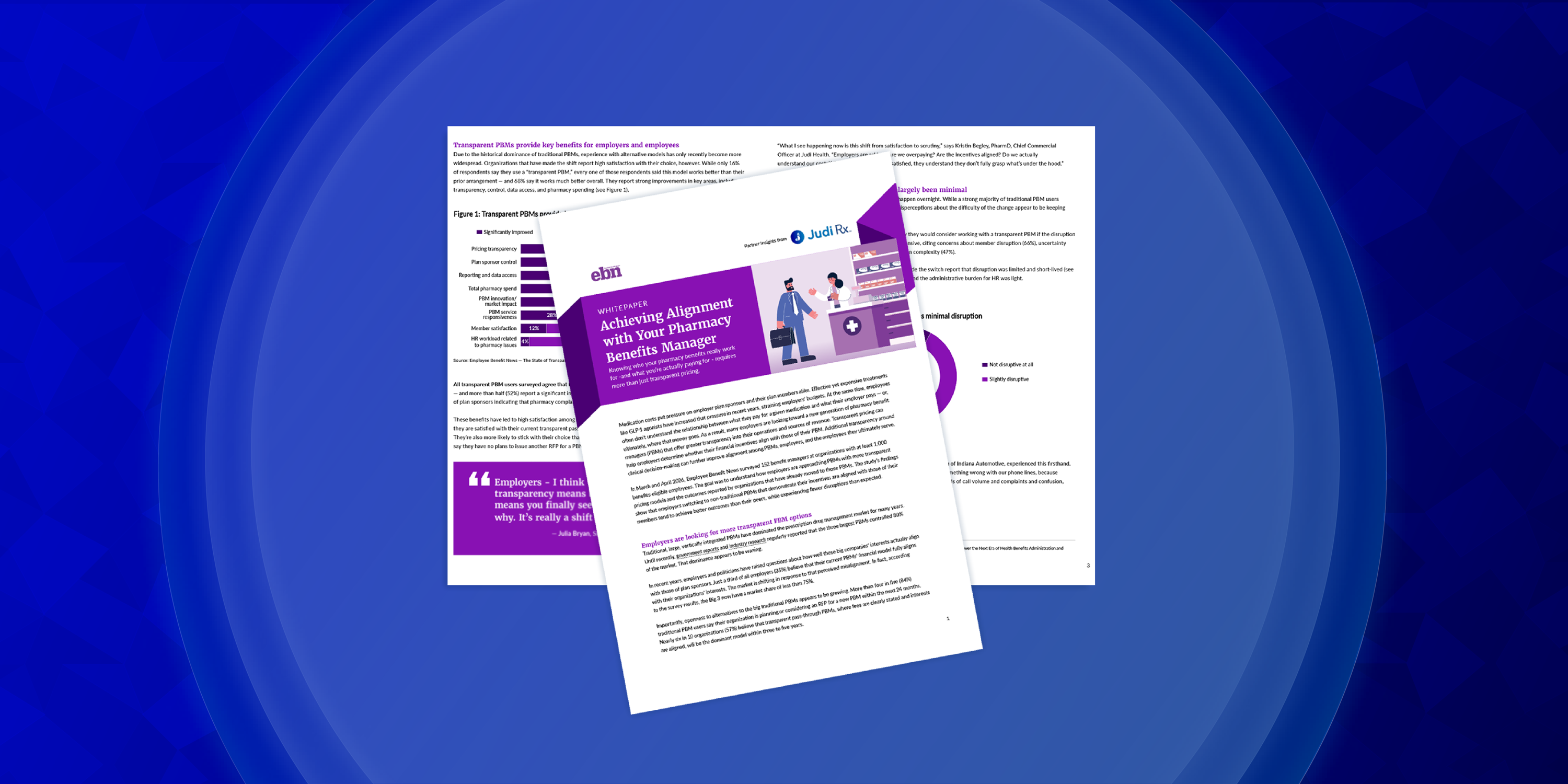
Achieving Alignment with Your Pharmacy Benefits Manager

.webp)


What 152 Benefits Managers Told Us About Switching PBMs
Every employer wants to believe their pharmacy benefits manager (PBM) is working in their best interest. But how many can prove it?
That question sits at the center of a new research report from Employee Benefit News, conducted in collaboration with Judi Rx™. Between March and April 2026, EBN surveyed 152 benefit managers at organizations with 1,000 or more benefits-eligible employees, all with a stake in health benefits decision-making.
The goal: understand how employers are thinking about their PBM relationships and approaching the decision-making process re. switching to more transparent pricing models. We also asked about what happens after they make the switch, and the results may – or may not – surprise you.
Download the full whitepaper, "Achieving Alignment with Your Pharmacy Benefits Manager," to learn more.
The Market is Absolutely Losing Confidence in the Status Quo, and It’s a Good Thing
Our survey findings reveal a market in transition and awareness that plan sponsors working with traditional PBM may not actually know where their money goes.
For years, three large, vertically integrated PBMs have controlled the prescription drug management market. That dominance is finally starting to slip. The Big 3's market share within our sample has fallen below 75%, and for good reasons.
- Just 35% of employers believe their current PBMs’ financial models fully align with their organizations’ interests – i.e., most plan sponsors suspect, or outright believe, that their incentives and their PBMs’ incentives are at odds.
- Nearly three-quarters (72%) of respondents believe overall cost transparency matters more than rebate levels.
The appetite for change reflects employers’ skepticism pf the traditional model.
- More than four in five (84%) traditional PBM users say their organization is planning or considering an RFP for a new PBM within the next 24 months.
- 57% of respondents believe transparent, pass-through PBMs, where fees are clearly stated, and interests are aligned, will be the dominant model within three to five years.
What Happens After Employers Switch to a Transparent PBM Model?
Openness to change is one thing. Results are another. This is where the report's findings become difficult to ignore.
Among the group of respondents using transparent PBMs, the outcomes are strikingly consistent:
- 100% say the transparent model works better than their prior arrangement, and 68% say it works much better
- 100% report improved total pharmacy spending, with 52% reporting significant improvement
- 84% say member complaints have declined since switching
- Plan sponsors also report gains in pricing transparency (80% significantly improved), plan sponsor control (72%), and reporting and data access (68%)
- More than two-thirds (68%) have no plans to issue another RFP within the next two years, a notable contrast to the broader market's RFP activity
Employers sometimes assume transparency means bare-bones. But in reality, it means you finally see what you're paying for and why. It's really a shift from guessing to knowing." - Julia Bryan, SHRM-SCP, Benefits and Compensation Manager at Subaru of Indiana Automotive
Any Disruption Employers Fear Rarely Materializes
If the results are so clear, why hasn't the entire market already moved to transparent PBMs?
The report points to a familiar culprit: fear of change.
Nearly four in five traditional PBM users (78%) say they'd consider a transparent PBM if the disruption were minimal; however:
- 66% worry about member disruption
- 57% worry about cost savings uncertainty
- 47% worry about implementation complexity.
The data suggests those fears don't match reality. Among employers who've already made the switch, 92% say the transition was not disruptive at all or only slightly disruptive for plan members.
Bryan experienced this directly during her organization's own transition. "We honestly thought there was something wrong with our phone lines, because we weren't getting any phone calls," she says. "We were ready for all kinds of call volume and complaints and confusion, and it just didn't materialize."
The Big Picture
"The market is really transitioning away from opacity to transparency. Employers don't need to take this leap of faith anymore. The data is showing that when you can achieve transparency, you can achieve better cost control and stability at the same time." - Kristin Begley, PharmD, Chief Commercial Officer at Judi Health
That's the throughline across every data point in this report. Employers aren't just tolerating transparent PBMs, they're reporting measurably better outcomes, fewer complaints, and minimal disruption. The organizations still hesitating aren't avoiding risk. They may be sitting with it, without realizing the extent of it.
The full report and webinar - The Next Era of Pharmacy Benefits - dig deeper into the numbers behind this shift: how satisfaction and scrutiny coexist, what employers wish they'd known before switching, and what a genuinely aligned PBM relationship looks like in practice.
Get in touch with our team if you're interested in discussing transparent pharmacy and medical benefits solutions for your organization!




.webp)