AH112 - From Transparent PBM to Unified Health Technology, with AJ Loiacono and Kristin Begley

.webp)


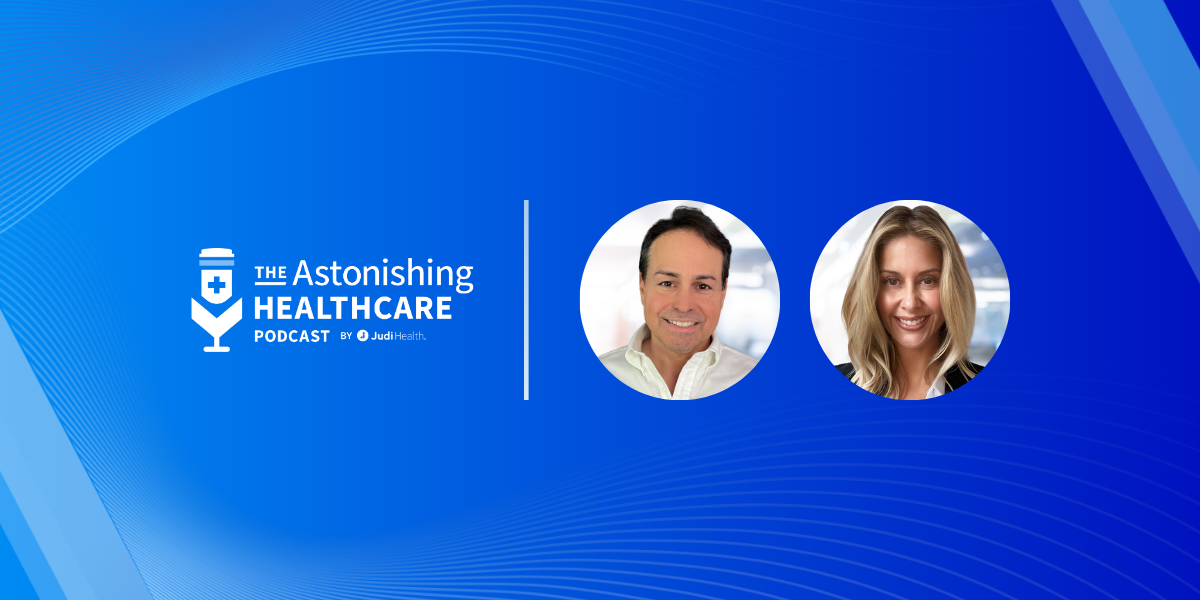
What does it take to move from fixing one broken corner of healthcare to reimagining the whole thing? On this special episode of Astonishing Healthcare, host Justin Venneri sits down with two of his favorite guests together for the first time: Judi Health's CEO, AJ Loiacono, and Chief Commercial Officer, Kristin Begley, PharmD.
The catalyst for this special episode is the company's rebrand, the evolution from Capital Rx, the transparent PBM that built Judi®, into Judi Health, a unified health technology company. AJ and Kristin explain why the "Rx" designation remains a core piece of the company's identity, but no longer fully represents the organization's evolving mission. They also describe the difference between "little T" transparency and the real thing, why incentive alignment matters so much, and what it took to build the first platform to process medical, pharmacy, dental, and vision claims on one system. They also express gratitude to the team and share bold predictions for where health benefits go next.
Key Takeaways
- The rebrand reflects an expanded mission, not a new one. Capital Rx launched as a transparent PBM, with "Rx" signaling its focus on pharmacy. Over eight years, the company broadened its administrative capabilities, including medical claims processing, and much more - all powered by Judi. Thus the primary brand: Judi Health, with services harmonized as Judi Rx (pharmacy), Judi Care (medical administration, TPA, navigation), and Judi Cloud (platform licensing for health plans and TPAs).
- There's a real difference between "little T" transparency and true transparency. AJ argues that true transparency means an auditable workflow: full disclosure of all compensation, proof that every customer receives the same pricing and benefit, and no hidden earnings. He calls out the "little H" holding company trick, and explains why alignment yields better outcomes for plans and their members.
- Nobody had built unified claims processing before. AJ recalls initial skepticism around unified claims. His response: "if Netflix had kept mailing DVDs, we wouldn't be talking about Netflix." To date, no other organization has built a unified claims processing platform. Judi is the exception.
- Unified claims processing will become the standard. Once employers realize they have options, markets shift quickly. AJ, who predicted the rise of transparent PBMs, makes a new call: unified claims will be the industry norm.
In this special episode of the Astonishing Healthcare podcast, Judi Health CEO AJ Loiacono and Chief Commercial Officer Kristin Begley, PharmD, explained the organization’s rebrand under the Judi moniker. The change reflects an expansion beyond pharmacy into a Unified Claims Processing™ technology framework, with medical, pharmacy, dental, and vision claims all living under one roof
The conversation covers everything about the official rebrand, the difference between “little t” transparency and True Transparency, why a unified claims platform is so critical to the future of healthcare, and what the future holds.
Why Rebrand to Judi Health™?
As AJ explained, Capital Rx started with a simple premise that he’s mentioned a few times, including on this podcast’s first episode: “To fix the problem, we had to become the problem – become the PBM.” As a transparent pharmacy benefit manager (PBM), the “Rx” designation in the company’s name signaled that focus: to change the way prescriptions are priced and patients are cared for to create enduring social change.
Over the last eight years, that focus has broadened and evolved, especially with the creation and expansion of our proprietary Enterprise Health Platform, Judi® - “the brains of our organization” AJ notes. With Judi, the mission evolved and broadened to its current point: tackling medical claims processing on a unified platform, delivering holistic and unbundled health benefits administration, and – above all else – delivering the electronic infrastructure our nation needs for the healthcare we deserve.
In effect, this rebrand serves as a recognition of that evolving mission, with every division harmonized underneath the Judi Health parent brand.
- Judi Rx™: Our transparent, pass-through pharmacy benefit model that has defined the company since its founding.
- Judi Care™: Our medical, dental, and vision solutions.
- Judi Cloud™: Our licensing division, enabling health plans and third-party administrators (TPAs) to leverage Judi to lower their operating costs, accelerate product innovation, and improve operational scalability.
Kristin elaborated on the evolution: “The mission hasn’t changed. It’s our ability to execute that has expanded.”
Judi was officially launched in 2021, and over the last 5 years that infrastructure has grown in scope and capability. This rebrand unifies those enterprise healthcare solutions under one cohesive identity.
What's the Difference Between "Little t" Transparency and True Transparency?
These days, the word transparency has become ubiquitous within pharmacy benefits. But AJ notes that there’s a difference between talking the talk and walking the walk.
Specifically, AJ recalled what some of those early battles were like when transparency was an unpopular position.
“We had to fight every day of every week, I would say, for a period of almost seven years...What I like to point out is that we won the war. Everybody is converting to our model. Suddenly, everybody's transparent.”
The real distinction between “little T” transparency and True Transparency, AJ argues, comes down to an auditable workflow. That means:
- Full disclosure on all compensation, whether through assets owned or flow of funds.
- Consistent pricing so every customer receives the same pricing and the same benefit, with no difference between big and small clients.
- Accountability that shows up in a company’s restated earnings if money were being made in hidden ways
AJ also warns about a common trick that he calls a “little h” holding company. A holding company routes rebates or reimbursements, then doles out payments to the operating PBM, which then claims it passes through 100% of what it received.
“You sound like a traditional PBM,” he says of that setup. The problem is that “everyone just assumes transparency is universal, some sort of magical standard that, if you just say ‘transparency’ you are.”
Kristin added a critical point that often gets missed: transparency alone isn’t enough if incentives aren’t aligned. “You can’t disclose a lot of information and still have a business model that benefits when costs go up,” she noted. “You shouldn’t be with a partner that makes more when you spend more, even if it’s transparent.”
“Transparency is visibility, alignment is accountability. Employers used to ask, ‘Can I see it?’ Now they’re asking, ‘Can I trust it?’” - Kristin Begley, PharmD
Why Build the First Unified Claims Processing™ Platform?
The boldest part of the story is Judi Health’s Unified Claims Processing system, which processes medical, pharmacy, dental, and vision claims.
But, as AJ recounts, the idea wasn’t the easiest to sell initially. There were plenty of skeptics. The natural reaction when he initially presented the concept four years into the company’s life was: “You’re a good PBM? Why not stick to that?”
“If Netflix just kept mailing me DVDs, we would not be talking about Netflix anymore,” AJ explained. “Technology and patient requirements evolve at speed, and an organization has to keep pace.”
Why did so many doubt it could be done? Well, simply put, nobody in history had processed medical, pharmacy, dental, and vision benefits on one system, with eligibility, benefit administration, and TPA payments. It still doesn’t exist outside of the Judi platform. Not even Fortune 10 giants have built a platform with these capabilities.
The current system, by contrast, is what AJ calls a “spaghetti chart of sorrow,” with far too many vendors, or “rent seekers,” touching each claim and creating abrasion for providers, pharmacists, and patients alike.
Resistance, Kristin explained, often isn’t about whether something can be done. It’s about challenging assumptions people have lived with for decades.
“No one would intentionally build fragmented healthcare with a bunch of rent seekers, and pay too much money, and have a bad experience if they were starting from scratch today. And I think that's one of the things that AJ is really visionary on: hiring people from the industry that said, What made their jobs hard and inefficient, here's your blank sheet of paper. We're going to do this the right way.” And once clients see pharmacy medical eligibility, all of these things operating together, what that feels like when you call to one call center and you don't get transferred to another, it is hard to imagine going backwards.” - Kristin Begley, PharmD
What Drives the Mission Behind Judi Health™?
Both leaders returned repeatedly to the human stakes.
AJ defined healthcare, “unfortunately, as an arbitrage on patient ignorance,” a highly opaque and complex process that turns patients into “uninformed price tickers.” It’s a system, he notes, that makes medical costs the number one cause of bankruptcy in the nation.
“People are fearful of using health care,” he said. “Why should you be afraid of getting healthier or being taken care of?”
Kristin, a pharmacist, spoke candidly about leaving the PBM industry before returning to Judi Health. She left, she said, out of frustration with “a system that often rewarded the complexity,” a place that felt like “being plugged into the matrix,” full of deals that look too good to be true, because they are. What brought her back was the chance to build something fundamentally different.
“Every time a client tells us they finally understand where the money’s going, that’s a win,” she said. “And every time a member’s experience gets easier, that’s a win for me, too. The pharmacist in me loves that.”
That discipline shows up in a choice AJ describes plainly: refusing what he calls the “gray dollars.” Industry peers ask him why he doesn’t just take the rebate dollars or the spread.
“The moment I take the gray dollars, you’re addicted to that money,” he explains. “Your board expects the revenue, your budgets are built around it. But more importantly, you become like everybody else.
What's Next for Judi Health™ and Healthcare?
At the end of the discussion, AJ and Kristin were asked for a prediction over the next three to five years.
Just as AJ predicted years ago that transparent PBMs would become the standard, he now makes the same call for unified claims. “Unified claims will be the standard.” For more than 25 years, pharmacy and medical drifted apart “like continental drift,” each on its own island with separate consultants, teams, and brokers. Yet, care is care. When a physician recommends both a procedure and a prescription, the patient doesn’t move to a different room and meet a new group of people.
Kristin’s prediction was just as direct: “Once employers realize they have options, markets change. And we’re watching that right now.
Want to learn more about our rebrand and Judi Health’s mission? Click here to read our press release!
Frequently Asked Questions
What is Judi Health™?
Judi Health™ is a health technology company providing benefit administration solutions to employers, unions, health plans, and government entities. Judi Health replaces fragmented, outdated systems with the industry's first Unified Claims Processing™ architecture, seamlessly consolidating pharmacy and medical benefit administration on a single, secure platform. By delivering true price transparency, eliminating unnecessary middleman fees, and leveraging advanced AI-powered care delivery, Judi Health helps clients achieve unprecedented operational efficiency and service levels.
What Services Fall Under Judi Health™?
- Judi Rx™: Our transparent, pass-through pharmacy benefit model that has defined the company since its founding.
- Judi Care™: Our medical, dental, and vision solutions.
- Judi Cloud™: Our licensing division, enabling health plans and third-party administrators (TPAs) to leverage Judi to lower their operating costs, accelerate product innovation, and improve operational scalability.
Where Did the Name “Judi®” Come From?
Judi is short for adjudication. This cloud-native, unified enterprise health platform is “the brains of our organization.”
What is the difference between transparency and alignment in healthcare?
As Kristin explains, transparency is visibility, meaning you can see the information, while alignment is accountability, meaning your partner's business model doesn't profit when your costs rise. A company can be transparent and still benefit financially when you spend more, so both matter.
What is a unified claims platform?
A unified claims platform processes medical, pharmacy, dental, vision, and ancillary benefits together on one system, along with eligibility, benefit administration, and TPA payments. Judi is the only platform that does this in the United States.

Lightly edited for clarity.
[00:22] Justin Venneri: Hello, and thank you for tuning in to a special episode of the Astonishing Healthcare Podcast. Hopefully this is a nice surprise between bi-weekly episodes. I'm excited to have two of my favorite guests here for the first time together, actually, which is astonishing to me. So I have Judi Health CEO AJ Loiacono and our Chief Commercial Officer, Kristin Begley. I think it's probably just a function of your travel schedules that's made it impossible to get you both on the podcast together. But thank you so much for joining me today.
[00:48] AJ Loiacono: Thank you for having us.
[00:49] Justin Venneri: Okay, so last time you were on the podcast, AJ, we walked through the ages of indifference, confusion, and acceptance. That was a fun episode for number 100. And Kristin, you're an OG podcast guest too. Last time you were on, we discussed the shift in demand and potential appeal of unbundling and an agnostic, aligned benefits model, and how that works. A whole lot has happened recently, so we had to do this. And that includes our official rebranding, the catalyst for the special episode. There's also been a flurry of regulatory activity, more movement by the big three to present themselves as transparent, and some consolidation among smaller players. So it's a great time to have you both back on the show.
AJ, let's just start off with the rebrand. We announced the start of this around our Series F and Charlotte Hornets partnership. Can you share your view on the evolution here? What led us to this point?
[01:35] AJ Loiacono: Yeah, of course, Justin. So we started the organization, I often say, to fix the problem, we had to become the problem, become the PBM. And as a transparent PBM, our name was Capital Rx, the Rx designation representing our focus in pharmacy benefits. Over the last eight years, we've obviously broadly expanded our services to not just include the capabilities of pharmacy services, but now also medical benefit administration, payments, and other areas. And so as we expanded as an organization, it became clear we needed to move beyond the Rx designation of pharmacy only and move to health to broadly represent all of the services that we do and deliver at Judi.
And so Judi Health became the parent company name. Then we started to harmonize all of our divisions within Judi Health. So Capital Rx, we're proud to state, is being rebranded, finally, as Judi Rx. I say finally because when you operate in all 50 states across Medicare, Medicaid, commercial, fully insured, and self-insured, to unwind those designations takes quite a bit of effort and work. So obviously I want to take a moment to acknowledge the effort not just of marketing, but also legal and compliance.
The other area, obviously, is Judi Care, which is our medical administration. So this is services around TPA, benefit administration, payments, navigation, et cetera. And then Judi Cloud, which is for our enterprise customers, typically TPAs and health plans that want to license the Judi platform. If you think about it, everything is a reflection of Judi. Judi is short for adjudication, and she is the brains of the organization. So what better name and brand to highlight than the genius behind all of those workflows and tens of millions of claims that flow every month.
[03:38] Justin Venneri: Got it. And Kristin, why is it so important today? And as our commercial and marketing leader, what does this mean to you?
[03:44] Kristin Begley, PharmD: I would say from a customer perspective, the most important thing to understand is the mission hasn't changed, it's our ability to execute that has expanded. Many people still thought of us primarily as a PBM, and the reality is we've been building the infrastructure quietly for almost five years for this much bigger transformation in healthcare. This evolution unifies the enterprise healthcare solutions under a single, cohesive brand identity. We're really excited about it and the future, and we're going to talk about a lot of fun things today.
[04:15] Justin Venneri: Oh, yeah. So, making this move now, what could you share about the process? Kristin, do you want to take that first?
[04:20] Kristin Begley, PharmD: I'll just say our clients had increasingly been asking us to solve problems beyond pharmacy. Some clients actually gave us this idea years ago to start doing this because of their outcomes and results, patient satisfaction, and truly lowering costs. Healthcare doesn't experience pharmacy, medical, dental, and vision separately. Patients experience healthcare together, in aggregate, and our brand needed to reflect that reality. So the technology was already there, the capabilities were already there. Now the brand simply catches up to the vision.
[04:51] Justin Venneri: Got it. AJ, there are a lot of players out there, more than ever before, claiming that they're "transparent." But you wrote an article on LinkedIn. We'll link it in the show notes, of course, along with your former episodes and some other good stuff. There's a pretty big difference between little "t" transparency, as you called it, and true transparency. Can you talk to us a little bit about that and why it's so important to understand this distinction in the context of broadening the services to try to address benefits beyond pharmacy benefits?
[05:18] AJ Loiacono: Well, let's start by stating the facts here, which is that when we started this company, we were very unpopular in our opinion that transparency matters. Fiduciary responsibility for the ultimate payers matters. What I would say is abiding by ERISA, if you're an ERISA-based plan, on both disclosures of compensation, plus, obviously, responsibility to your members. It was a very unpopular topic, and we had to fight every day of every week, I would say, for a period of almost seven years.
And a combination of the amendment to the Consolidated Appropriations Act, which obviously amended ERISA Section 408, triggered what I would say is the beginning of brokers and consultants rethinking the importance of this topic, and employers rethinking the importance of it. What I like to point out is that we won the war. Everybody is converting to our model. Suddenly, everybody's transparent.
But the point here, more than anything else, is there's a huge difference between transparency and what I would say is an auditable workflow that demonstrates not only full disclosure on all compensation through assets owned or the flow of funds to benefit your organization, but also the ability to demonstrate that all of your customers are receiving the same pricing and the same benefit. Because there shouldn't be any difference if you're truly transparent. There should be no difference between big and small. Also, if you were making money in this manner, you should be restating your earnings as a publicly traded company. We'll wait to see that.
But I think, more importantly on this topic, even entities that are newer entrants to the industry or mid-tier PBMs claim to be transparent. And I feel like we should do an entire segment on the little holding company trick: "I have a holding company, and that flows through the rebates, or that flows through the reimbursements, and then I dole out the payments to the operating PBM, and the PBM gets to say I am transparent, and I could show you that I passed through 100% of what I received." I go, you sound like a traditional PBM, and nobody asks questions. Everyone just assumes transparency is universal, some sort of magical standard that if you just say transparency, you are. So, yes, I continue to be, what I would say, a staunch advocate for transparency, but true transparency. And I am going to put all of our competitors to the test.
[07:53] Justin Venneri: Kristin, what would you add there? What else should plan sponsors know about this test, whether it's questions they should ask or things to be aware of? What else do we need to talk about when we're talking about this transparency discussion?
[08:04] Kristin Begley, PharmD: I a thousand percent agree with AJ on all of his points, and I would just add one thing I think gets missed. Even if they got to true transparency as AJ describes, it's only valuable if the incentives are aligned. Meaning, you can disclose a lot of information and still have a business model that benefits when costs go up. You shouldn't be with a partner that makes more when you spend more, even if it's transparent. I think employers were asking, "can I see it?" Now they're asking, "can I trust it?" So transparency is visibility, alignment is accountability. Seeing the math is important, but making sure nobody profits from the wrong answer is even more important.
[08:45] Justin Venneri: That's a great point we've discussed on the podcast before many times, honestly. Kristin, you've mentioned specifically how you left the PBM industry due to what it was turning into, but you returned to join the mission here. What has it been like for you to watch Capital Rx evolve into Judi Rx, and then Judi Health evolve from Judi, to see our platform evolve the way it has?
[09:04] Kristin Begley, PharmD: I'll start with, I am a pharmacist. That was a very difficult decision to leave the PBM industry and go into navigation and women's health. I didn't leave the pharmacist industry because I stopped caring about healthcare or the PBM. I left because I became frustrated with a system that often rewarded complexity. It's a mirage of value. The deals that look too good to be true, they are too good to be true. These prices or deals don't even exist.
So what brought me back, besides being able to work with one of my mentors again, AJ, and many other people he had hired along the journey that we met, was the opportunity to be building something that was fundamentally different. I get to wake up every day knowing that we represent what's ultimately improving healthcare and patient experiences. That's a special place to be. Your job matters, and you are making contributions to the world. So every time a client tells us they finally understand where the money's going, that's a win. And every time a member's experience gets easier, that's a win for me too. The pharmacist in me loves that.
[10:05] Justin Venneri: That's amazing. It's always fun to hear from our clients, either how implementation goes smoothly, or how they feel like their members are better cared for, or just that they have more control over their plans. So it's definitely a good outcome.
[10:17] Kristin Begley, PharmD: One more thing. What's really exciting to me is that we've proved transparency could work in pharmacy, and now we're asking that much bigger question: what happens when you apply those same principles across healthcare? And frankly, it's the same on the medical side. Fake prices with fake discounts equals fake value on the spreadsheet, and for patients, driving costs up. So I'm really excited about creating a better experience that costs the system less. And we're going to get rid of some rent seekers in the system, as AJ loves to call it.
[10:43] Justin Venneri: That's a perfect transition. Thank you for adding that. AJ, many people balked initially, and you talked about how much of a street fight it was on the PBM side of things to grow the business and gain acceptance. People didn't really love the idea, or they liked the idea but didn't think it was possible to build and deploy a unified claims processing system. Now that we're on the other side, with Judi powering a unified experience, why do you think there was so much disbelief or resistance to the idea, and what are we doing about it?
[11:10] AJ Loiacono: Yeah, I always want to say the disbelief was at the highest levels in our organization: my board of directors. We'd been a PBM, I think, at that point, for maybe four years, and we were having very good growth. It was an excellent business by any measure during that period. And I remember presenting to my board of directors, strategically, that we were going to invest in Unified Claims. I had to explain this concept to them. And I was not greeted with warmth and acceptance, let's just put it that way.
[11:41] Justin Venneri: And.
[11:41] AJ Loiacono: And I've talked about this before, which is, your board is obviously there to govern you, challenge you, and support you. I think at first, the natural reaction to a company that was still very young was, "you're becoming a great PBM. Why don't you just stick with that?" And my response is, if Netflix just kept mailing me DVDs, we would not be talking about Netflix anymore. I think in the modern age, and I talk about this all the time, the speed at which technology evolves and patient requirements evolve, you as an organization must keep up with that velocity and pace.
And so for me, it was a natural evolution, because once you understand how claims are administrated in the United States, it's a spaghetti chart of sorrow. I almost feel so sorry for the providers and the abrasion they face, be it on the prescribing side or even on the procedure and care side. You see it with the pharmacist, you see it with the plan and the patient. A lot of it is incurred by far too many vendors that are rent seekers touching these claims.
So I go back to the beginning: I had to convince my board of directors that this was a reasonable step. I would like to say it was a very shrewd strategic plan. And I use the word "shrewd" because for us to truly transform healthcare, I go back to zero dependencies. I find that not too many people have earned my trust, or our organization's trust, over the years. So for us, we needed to build out this full suite of applications and services, not just for ourselves. We have plenty of absolutely wonderful partners I want to empower and give them those tool sets: TPAs we work with, regional health plans we work with, Blues plans. I think they are very good actors, and they just require additional tool sets to deliver better care, better service, and better insights more efficiently across those services.
But going back to my board, it was not fun. You asked the question, why did people believe this was a difficult decision or a challenging idea? And the reality is, no one had ever done it before. I remind everybody on this podcast that is listening, nobody in the history of this country had been processing medical, pharmacy, dental, vision, et cetera, and ancillary benefits on one system with eligibility, ben admin, TPA, payments, et cetera. It does not exist, and still does not exist, with the exception of the Judi platform.
So immediately, when you go to an investor or any governance committee and you say, "I would like to attempt to do X, and no one has ever done it before, and there are multi-billion dollar companies, Fortune 10 companies, need I remind you, Cigna, CVS, United, that have never done this before," why are you the one who will do it? Why is your organization capable of this?
And I go back to something Kristin said earlier: alignment. Our mission is to give our country the infrastructure we need for the healthcare we deserve. I am asked all the time to define US healthcare. And I define US healthcare, unfortunately, as an arbitrage on patient ignorance. It has been managed that way by incumbent and legacy health plans, often publicly traded ones. And it's sad. It's a highly opaque, complex process. I don't care if we're talking medical or pharmacy, because the more opacity and complexity there is, the patient becomes, unfortunately, an uninformed price ticker. And it's the reason why it's the number one cause of bankruptcy in this nation. People are fearful of using healthcare. Why should you be afraid of getting healthier or being taken care of?
That has tugged at my soul since the moment I entered the payer space. And I am proud of the commitment of my investors, my colleagues, and the execution of all of our teams to bring us to this point in time, and to say we are going to usher in a new era of better care, more help than anyone has ever received. I often say a lack of patient confidence is why we have substandard care. This is completely taken care of when you get rid of the opacity, the complexity, and the self-interest at the center of healthcare, and focus on what really matters: providing the highest level of care and insight for patients at the lowest available price point, free of any third-party interference. Full stop. And I'm excited about that. And we're doing it. And we'll talk more about that, I'm sure.
[16:22] Kristin Begley, PharmD: Yeah.
[16:22] Justin Venneri: Kristin, you mentioned these expanded capabilities, focusing on the core of pharmacy benefits, and then we have these expanded capabilities. Is there something that pops up in your discussions with prospects or with clients where they're like, "you know, I do see how these things are being done two, three, four times for different benefits. Maybe I can pull that all in"? How are those discussions going, just out of curiosity?
[16:42] Kristin Begley, PharmD: Well, think about the olden days, when they said the world was flat, and then someone actually figured out the world was round. Sometimes resistance isn't because something can't be done. It's because it challenges assumptions that have always existed for decades. People have become accustomed to separate systems because that's how healthcare grew up, not because it was the best way. So no one would intentionally build fragmented healthcare with a bunch of rent seekers, and pay too much money, and have a bad experience, if they were starting from scratch today.
I think that's one of the things AJ is really visionary on, and hiring people from the industry who said what made their jobs hard and inefficient. Here's your blank sheet of paper. We're going to do this the right way. And once clients see pharmacy, medical, and eligibility all operating together, what that feels like, when you call one call center and you don't get transferred to another, it's hard to imagine going backwards. So it's been really fun.
[17:39] Justin Venneri: Cool, and AJ, you tell the story often, thinking back to when it was just you and a handful of others in the small office with a plant over your shoulder, like the Zoom background here. What do you reflect on as you see us evolve and Judi Health continue to grow?
[17:50] AJ Loiacono: You know, I go back to my original thought. When we started this company, the mission was very clear. It was evident to me that none of the major players wanted to act appropriately and deliver a truly transparent benefit solution to the market. And so, in order to fix the problem, we had to become the problem, become a PBM. You start with that mission. And the mission at the time was to change the way drugs are priced and patients are cared for, to create enduring social change.
I go back to my prior point. I believe in this concept of enduring social change, because a patient should never be confused or taken advantage of at the pharmacy register or the point of care. But unfortunately, that has been the business model for 30 years in the United States, and it has only become worse and worse.
So when we started back in that small office, the windowless office, I'd like to add, on Canal Street in New York City, we never envisioned the organization to be the size and scale, and to address the surface area of healthcare services that we do today. But it doesn't necessarily surprise me when I reflect. And the reason why: I genuinely believe if you have the experience and the expertise, you have the passion and discipline, and you surround yourself with equally talented people that embrace your mission, there is no limit to what you can accomplish. This has been shown with hundreds, if not thousands, of US businesses over the years. I don't care if we're talking about sneakers or semiconductors. Again, it comes back to being able to have the discipline.
And this is one thing that I kind of stitch back into transparency. Part of that discipline is not to take the gray dollars. I know everybody in US healthcare at this point, based upon my age and tenure and everything else in the industry. I'm just like an old soul in healthcare, I often joke. It's interesting. I will speak to executives at companies that provide similar, identical services. And they're like, "why don't you just take them? Just take the rebate dollars, take the spread. Submit those claims that you shouldn't be submitting for rebates." And I'm like, I refuse to do it. Because the moment I take the gray dollars, you're addicted to that money. Your board expects the revenue, your budgets are built around it. But more importantly, you've become like everyone else.
That's a huge part of this journey. I go back to the people that joined us on this mission: the executives, the associate-level colleagues, our investors that believed in the importance of our mission to truly improve and revolutionize healthcare. I go back to all of that. And I think for us, when I reflect upon the days of the windowless office and the plant, yeah, we've come a long way. But it doesn't surprise me when I think about the talent we've assembled and the heart that we have at this company. We are a compassionate, caring organization. And I could say everyone that works here that I've interacted with or hired, they believe in the same principles that I believed in that very first day with that little plant.
[21:06] Justin Venneri: Got it. And just a couple more questions for you both. Thank you for taking the time today. Of course, the most astonishing thing. Let's go with the rebrand. What's the most astonishing or surprising thing to you, AJ, about the rebrand and the effort thus far?
[21:18] AJ Loiacono: I go back to my original thanks. It's easy to say, "hey, we're going to rebrand Capital Rx." To execute on that promise is something completely different. And I have an entirely different level of respect for everybody who was involved with that process because of what an enormous undertaking it was. I often point out, and I think people understand this, there are legacy healthcare company names that still exist where you'll have a parent organization, and you'll have three or four differently named companies underneath that legacy healthcare company. And now I think I understand why, because the amount of care and execution and compliance and legal work required to get it done, it's an enormous undertaking. So again, I celebrate the contributions from marketing, compliance, legal, and communications. Tactically, anyone who worked on this, and if I'm overlooking someone, I genuinely apologize. But again, a huge undertaking.
And back to the Judi name. We always knew Judi was the heart and soul of this company and she would become the name. I think it's very funny. One of our investors, I'm going to call her out, Holly Maloney at General Catalyst. When I first presented to her, Capital Rx, her exact comment to me was, "Capital Rx, I love your business model. I love your passion, the expertise that you're executing. We absolutely hate the name of your company." And I said, well, stick with us. We are going to move to Judi Health and Judi Rx. It's going to take us some time. And it was actually quite funny, because it was almost in that moment that she was like, "okay, we'll partner with you then." That's great.
[23:04] Justin Venneri: Kristin, same question to you. What's been most surprising or astonishing, but maybe a little twist, from just a marketing and sales perspective? A reaction, or something you've reflected on since we started this and then finally announced it?
[23:15] Kristin Begley, PharmD: I was just at a sales pitch yesterday, and I'd say the most astonishing thing for me is how quickly people understand it once they see the whole picture working together. I feel like the market's finally ready for the conversation that AJ and I and all the other executives have had for years. On a personal note, I would say that to me, Capital Rx represented courage. It represented a company that was willing to challenge assumptions that most people thought were just untouchable. Capital Rx really showed what was possible in the industry. And Judi Health is expanding that into what is imaginable.
[23:49] AJ Loiacono: Yeah, I would like to touch on one additional point that Kristin brought up. In the United States, for the last 25-plus years, pharmacy and medical have separated like continental drift, but accelerated, in the sense that pharmacy is on its own separate island with its own separate consultants, with its own separate support team. Medical is on its own different continent or island with its own separate teams, consultants, and brokers. And I'm like, care is care. When I'm speaking with a nurse practitioner or a physician, and it involves both a procedure or some sort of care and then a prescription, they don't leave the room, and I'm not introduced to a new group of people. Your benefit is your benefit. The moment you see pharmacy, medical, dental, vision, and eligibility accumulated, all operating perfectly in real time, you are never going back to the spaghetti mess of member, provider, and plan abrasion. I guarantee it. This will be the standard going forward, the same way I made a prediction eight and a half years ago that transparent PBMs were going to be the standard going forward. Here I am. Let me help the industry again. Unified Claims will be the standard again, and you heard it on this podcast.
[25:07] Justin Venneri: I was about to ask you for a prediction for the next three to five years, but you just beat me to it. I think we have it. Unless you want to throw in another movie?
[25:14] AJ Loiacono: Throw in one yourself.
[25:16] Justin Venneri: Give us a moonshot, Kristin.
[25:18] Kristin Begley, PharmD: I think once employers realize they have options, markets change quickly, and we're watching that right now. I think AJ's was better to end on, to tell you the truth.
[25:28] Justin Venneri: Well, you both have given us plenty to think about, and I really appreciate you taking the time. So thank you for joining me in the studio, both of you, for the first time, and I look forward to having you back on, either separately or together, in the future.
[25:40] AJ Loiacono: Yeah, we didn't have one fight on air. This is amazing. Thank you so much, guys. Thank you.




.webp)