Driving Cost Savings and Clinical Outcomes in Obesity Management


.webp)


More than 100 million U.S. adults are currently considered obese.1 While healthcare providers are seeking effective treatments, the demand for weight-loss medications has skyrocketed. In fact, in 2023, GLP-1 utilization in the U.S. resulted in a total of $71 billion – a 500% increase from 2018.2 To make matters worse, average medical cost over a one-year period upward of $46,555 for a patient with all cardiodiabesity conditions vs. $21,139 for a patient with one condition (average pharmacy cost was $11,630 versus $5,547).3
As a result, employers and health plans are seeking cost containment strategies that will enable them to support their members’ health without breaking the bank.
Enter Rx Activate: a clinical program implemented in partnership with Vida Health that is designed to support individuals working toward their health goals.
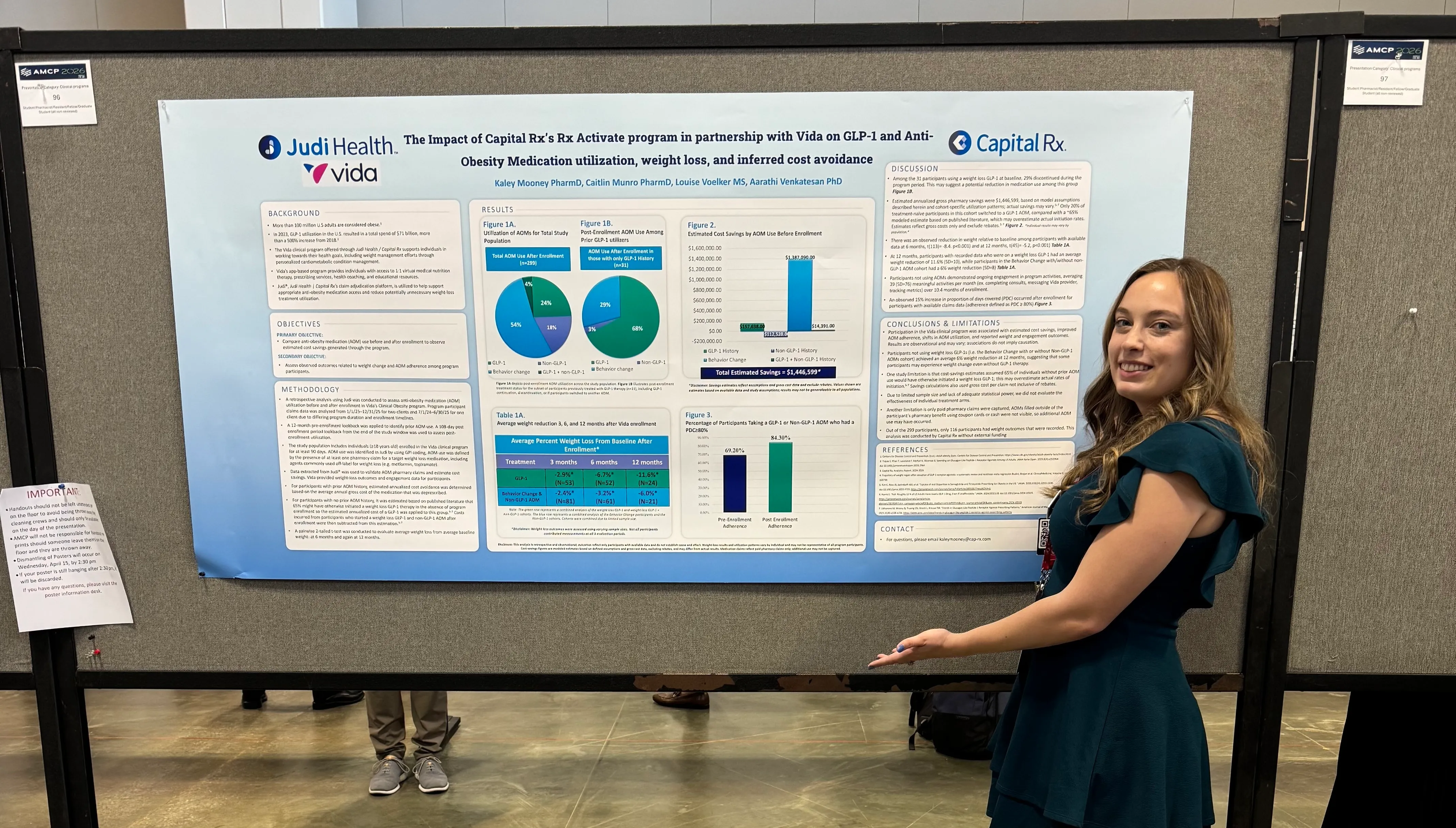
During the 2026 AMCP Annual Meeting, Kaley Mooney, PharmD (PGY-1 Managed Care Resident) presented a poster diving into a unique study, completed with Caitlin Munro, PharmD (Senior Manager, Clinical Programs, Judi Health), Louise Voelker, MS (Manager, Business Intelligence and Healthcare Analytics, Vida Health), and Aarathi Venkatesan, PhD (SVP, Business Intelligence and Healthcare Analytics (BIHA), Vida Health).
Examining GLP-1 Utilization and Program Objectives
This study aimed to identify the impact of the Rx Activate program on GLP-1 and anti-obesity medication utilization, weight loss, and inferred cost avoidance.
"We conducted this study to assess whether an integrated, clinically guided obesity program could optimize GLP‑1 and other anti‑obesity medication use while maintaining meaningful clinical outcomes,” Kaley explained. “This was evaluated by comparing both pre- and post-enrollment medication use, adherence, estimated pharmacy cost savings, and weight loss outcomes."
Methodology and Data Analysis
To understand the impact of this program, our team conducted a retrospective analysis using Judi®, our enterprise health platform, and looked at anti-obesity medication (AOM) use among program participants before and after they enrolled.
Their approach:
- The team analyzed pharmacy claims data from three different clients. For two clients, we examined a standard 12-month period. The third had a slightly different timeline to match their program's duration.
- They looked back 12 months before enrollment to see if participants were already using AOMs. The team then evaluated medication use 12 months following program enrollment, using a 108‑day lookback period from the study end date to determine which medication participants ended on. To be included in the study, an adult had to be enrolled in the Vida program for at least 90 days.
- Using industry-standard GPI codes to identify AOMs, the team defined "use" as having at least one pharmacy claim for a target weight loss drug.
- Lastly, the team used Judi® to validate these claims and estimate cost savings.
Results: Weight Loss and Cost Reductions
The results indicate substantial shifts in medication use and expenditures:
- Among the 31 participants using a weight loss GLP-1 at baseline, 29% discontinued during the program period.
- Estimated annualized gross pharmacy savings reached $1,446,599 based on model assumptions.
- Only 20% of treatment-naïve participants switched to a GLP-1 AOM, well below the 65% modeled estimate.
- The team observed a significant reduction in weight relative to baseline at six months and 12 months.
- At 12 months, participants on a weight loss GLP-1 averaged an 11.6% weight reduction, while the behavior change cohort averaged a 6% weight reduction.
- Participants not using AOMs demonstrated ongoing engagement, averaging 39 meaningful activities per month over 10.4 months.
- Following program enrollment, there was a 15% increase in the proportion of participants with available claims data who achieved a PDC of ≥80%.
Dive Into the Study

The Path Forward for Obesity Management
Clinical partnerships integrated with transparent pharmacy benefit platforms offer a clear roadmap for managing rising healthcare costs. By combining behavioral support with accurate claims adjudication, plan sponsors can achieve better financial alignment and patient outcomes.
If you are evaluating your organization's strategy for anti-obesity medications, reviewing your clinical programs and PBM alignment is a critical first step. To learn more about transparent pharmacy benefit management, talk to our team today.
- Centers for Disease Control and Prevention. (n.d.). Adult obesity facts. Centers for Disease Control and Prevention. https://www.cdc.gov/obesity/adult-obesity-facts/index.html
- Tsipas S, Khan T, Loustalot F, Myftari K, Wozniak G. Spending on Glucagon-Like Peptide-1 Receptor Agonists Among US Adults. JAMA Netw Open. 2025;8(4):e252964. doi:10.1001/jamanetworkopen.2025.2964
- Do, D., Lee, T., Santana, C., Inneh, A., & Patel, U. (2024). Cardiodiabesity: Epidemiology, resource and economic impact. American journal of preventive cardiology, 20, 100887. https://doi.org/10.1016/j.ajpc.2024.100887