Prior Authorization Guide: Pharmacy, Medical, Dental, and Vision PAs

.webp)


Prior Authorizations can add friction to an already complicated healthcare experience. For members and providers, it can mean another step between a treatment recommendation and receiving care. But the process does serve an important purpose: helping ensure care is safe, appropriate, and covered by the member’s plan.
While often associated with prescription medications, the process can also apply to medical, dental, and vision care. What gets reviewed, who reviews it, and what happens next can look different depending on the type of care, and when a request isn’t approved, there are still steps a member or provider can take.
Prior Authorizations can feel like a roadblock, but understanding how they work, and how modern systems are making them faster, makes the whole process easier to navigate.
What is a Prior Authorization?
Prior Authorization (PA), also called preauthorization, precertification, or pre-approval, is a utilization management (UM) strategy that requires a more in-depth, usually clinical, review before a medication or service is covered by a health plan.
Why is a Prior Authorization Required?
The PA process can vary depending on the benefit, plan, and type of care being requested. The goals are consistent across benefit types:
- Determine that the care is medically necessary
- Confirm that the care aligns with the member’s plan and coverage
- Encourage cost-effective alternatives when clinically appropriate
- Add a layer of safety before care is delivered
How those goals are carried out matters, too. A well-run process should make it clear what information is needed, how a request is evaluated, and what happens next.
“A well-designed PA process should keep members well informed throughout the process. Clear expectations, timely communication, and transparent decisions help create a positive experience while supporting access to medications based on health plan coverage and benefit design.”
- Mel Shah, PharmD, Sr. Director of Utilization Clinical Management
For pharmacy benefits, those criteria can affect which medications require PA and how a request is reviewed. If a prescriber writes a medication with a dosing schedule that isn't supported by FDA guidance or clinical literature, a PA review can provide another layer of safety before a patient fills the prescription. Similarly, there are often multiple medications available for a given condition, and a PA review can help identify an appropriate option based on the member’s needs and coverage.
Who Determines When Prior Authorization is Required?
The criteria behind a PA decision comes from clinical evidence, coverage requirements, and plan design. In pharmacy, it starts with the formulary. Formularies are lists of covered medications and include UM edits, such as PA.
A Pharmacy & Therapeutics (P&T) Committee develops and maintains the formulary, reviewing clinical evidence, safety, efficacy, and other considerations when determining which medications are covered and what utilization management requirements apply.
Those decisions are grounded in national clinical guidelines and evidence-based practices. Across healthcare disciplines, experts develop guidelines that help inform providers and plans about appropriate care. PA criteria are intended to be objective and evidence based. On the medical, dental, and vision sides, plans apply similar criteria to determine which procedures, treatments, and services warrant review.
Misconceptions About the PA Process
Much of the claims adjudication process happens in the background, outside a patient's view. PAs are different because they can interrupt the care journey, from the point when a doctor prescribes a medication or recommends a procedure to the point when a patient receives it, which makes it easy to see why PAs are often viewed with skepticism.
That skepticism isn't entirely unfounded. In a 2024 national survey, the American Medical Association found that physicians and their staff spend an average of 13 hours a week completing PA requests. The survey also found that PA can contribute to delays in care and serious adverse events for patients.
State-level reform activity has also accelerated. In 2025, at least 26 states passed laws limiting how insurers use PA, and a coalition of health insurers pledged to streamline, simplify, and reduce the practice. The broader direction is clear: reduce administrative burden while preserving appropriate clinical review. At the same time, it's worth putting the pharmacy numbers in perspective: fewer than 3% of members who are prescribed medication need to go through the PA process at all.
That doesn’t mean PA is inherently a barrier to care. For the small share of members whose medications require it, PA can serve as a safeguard, helping ensure treatment is clinically appropriate and aligned with coverage. The challenge is making sure the process itself doesn’t create unnecessary barriers to accessing that care.
How Modern Technology Helps Improve the Prior Authorization Process
PA can serve an important clinical purpose, but the process surrounding it can create additional work for providers and review teams. Modern technology can help make the process more efficient by bringing the information needed for a decision into the workflow, reducing handoffs, and automating steps that don't require manual intervention.
When clinical and claims information is spread across disconnected systems, reviewers may have to track down information that already exists elsewhere, while providers may be asked to submit documentation that has already been captured in another part of the healthcare system. Judi®, our enterprise health platform, connects it all.
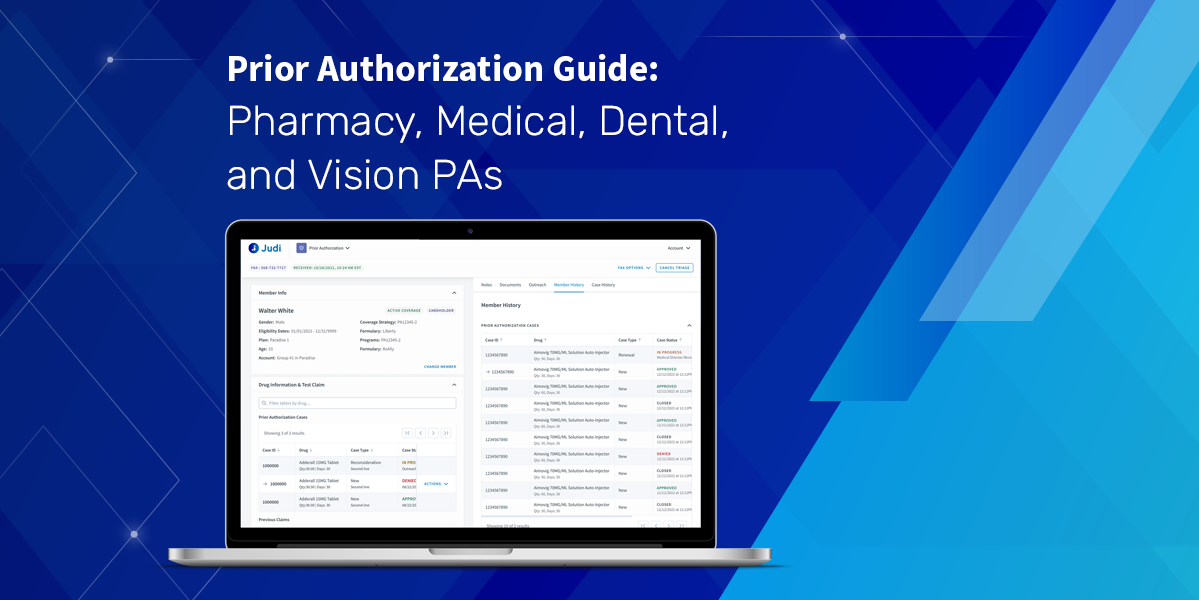
The Prior Authorization Tool (PAT) built within Judi gives benefits teams access to member history, real-time claim information, authorizations, and other relevant data within the PA workflow. Judi brings several capabilities to the PA experience:
- Bring information together: Give reviewers a broader view of member’s care when evaluating a request.
- Reduce manual work: Use AI to pull relevant information from documents and help create PA cases more effectively.
- Move straightforward requests forward: Automatically approve eligible requests that meet established criteria.
- Give members more visibility: Let members see the status of their PA requests through the member portal and app.
“How do we build the best software to change the industry and democratize that so that anyone that wants to work with us can use the products to make the experience for the provider and the member better?”
- Kevin Sundquist, VP of Product
A unified view of claims gives reviewers a broader picture of a member’s care when evaluating a request. Connecting the PA workflow to claims data, provides access to the context needed to make informed decisions without needing to piece it together across systems. The same approach extends into claims adjudication, where connected data can support benefits administration from the initial claim through the final decision.
What's the Difference Between Pharmacy, Medical, Dental, and Vision Prior Authorization?
PA can look different depending on the type of care being reviewed. Pharmacy PAs generally focus on prescription medications and related services, diagnostics, and devices, while medical, dental, and vision PAs can involve procedures, services, equipment, and other treatments. The information required and criteria used can vary, too.
Here’s how the four types compare:
Despite these differences, every type of PA is designed to evaluate whether requested care meets the applicable clinical and coverage criteria based on nationally accepted guidelines.
Why are Prior Authorizations Sometimes Denied?
A PA can be denied for several reasons, and a denial doesn't necessarily mean the requested care is inappropriate.
One reason is that the requested medication or service doesn't meet the clinical criteria for the member's diagnosis. For example, if a medication is prescribed for an off-label use, the reviewer evaluates whether available evidence supports its safety and effectiveness for that condition. The same logic can apply when a requested procedure isn't supported by clinical evidence for a particular diagnosis.
Missing information can also get in the way of a decision. When reviewing a request, the review team may need additional clinical details but be unable to reach the provider or obtain the necessary documentation. If that information isn't provided, the case may ultimately be denied.
Safety is another consideration. When the evidence doesn't show that a medication or service is safe and effective for the diagnosis in question, the reviewer may reach out to the provider, explain the reason for the decision, and recommend a more appropriate alternative.
The goal isn't to deny care. It's to help determine whether the requested care is appropriate for the member and supported by the available information.
“We are looking for reasons to approve medications. We want the right patient to get the right medication at the right time.”
- Sara Izadi, PharmD, Chief Clinical Officer
What Happens if a Prior Authorization is Denied?
A denial doesn't necessarily have to be at the end of the road. Members and providers may have the right to appeal, depending on the plan and applicable requirements. Understanding the reason for the decision can help determine the next steps.
Steps to take after a Prior Authorization Denial
- Understand the reason for the denial. Review the denial notice carefully to identify what information or requirement led to the decision.
- Talk to the provider. The provider may be able to revise the request, add clinical documentation, or submit updated evidence such as imaging or lab results.
- File an appeal. Appeal timelines vary by plan. Standard appeals can take up to 30 days, while urgent cases are typically reviewed much faster.
- Explore alternatives. Ask the care team whether another medication, treatment, or service may be appropriate and meet the plan's criteria.
A clear explanation of the decision matters. Members and providers need to understand not only that a request wasn't approved, but why. The same clarity depends on how information moves through the benefits system as a whole.
Making Better Decisions, Faster
Prior authorization is just one part of a healthcare benefits system that works better when the systems supporting it work together.
Judi brings pharmacy, medical, dental, and vision benefits together on a single platform, giving benefits teams the information and tools they need to administer benefits with greater clarity and consistency.
Learn more about how Judi Health is providing the electronic infrastructure our nation needs to deliver the healthcare we deserve.