AH097 - Stories from the Next Generation of Healthcare Disruptors, From Internship to Impactful Full-Time Work

.webp)


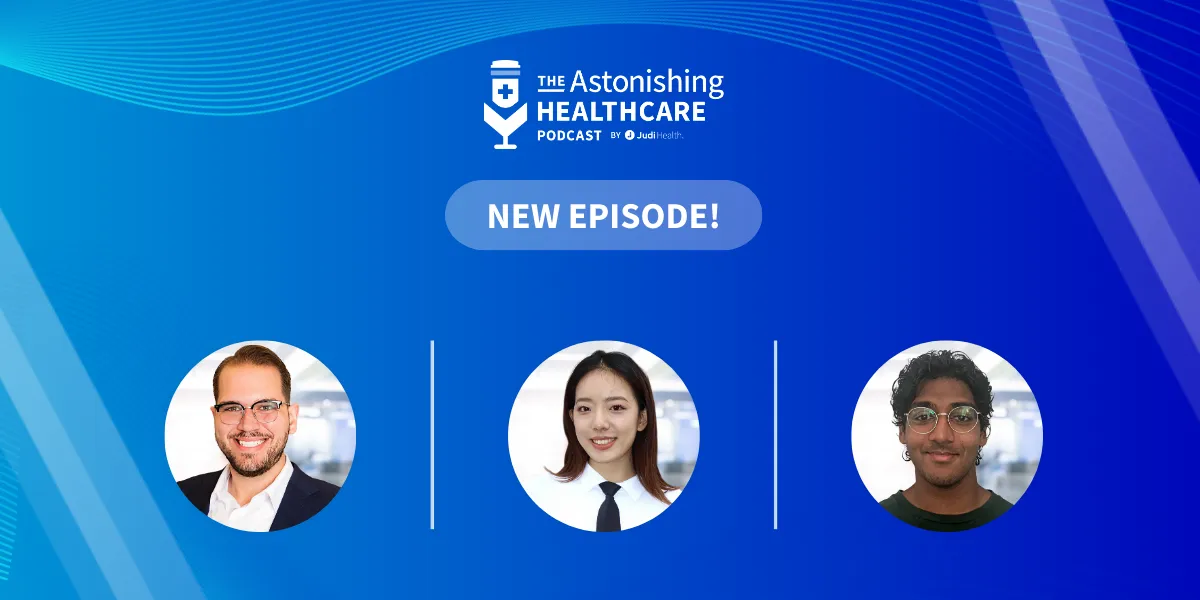
For Episode 97 of Astonishing Healthcare, we sat down with three team members who interned with Judi Health (Capital Rx) and recently joined our mission as full-time employees! Jakob Deel, Lisa Yu, and Bryan SebaRaj discuss their respective paths to Judi Health, from why they chose healthcare and how they found their internships to why they decided to join a newer, disruptive health tech company over larger "hyperscalers." So, this episode has something for every undergrad and graduate student.
That said, Episode 97 isn't just about landing an internship or transitioning from an intern to full-time employee. The trio also discusses the engineering, development, and operations/policy work they are doing to help advance our industry. Our goal is really to raise awareness of the different paths the next generation of healthcare disruptors can take, how to prepare if you're on that path, and highlight the reward at the end of this first step in what will undoubtedly be long and successful careers!
To learn more about life at Judi Health, check out our Careers Page, and keep an eye out for our 2026 summer internship program openings, which will be posted there soon.
Transcript
Lightly edited for clarity.
[00:22] Justin Venneri: Hello and thank you for listening to another episode of the Astonishing Healthcare Podcast. This is Justin Venneri, your host and Senior Director of Communications at Judi Health. And this episode should be a pretty fun one.... a lighter discussion compared to some of the other benefits-heavy, conflict-heavy, regulatory-heavy, et cetera, stuff that goes on in the health benefits space.
So we're doing this to help hopefully all the undergrad and graduate students out there who are thinking about making health tech or health benefits administration a profession, or maybe even those who are thinking about moving over into healthcare.
I have Jakob Deel, Lisa Yu, and Bryan SebaRaj in the studio with me today, all of whom have gone through our internship programs and ended up with full-time positions within the last year. Welcome to the show.
Bryan SebaRaj: Thank you for having us.
Lisa Yu: Yeah, thank you for having us.
Jakob Deel: Glad to be here, Justin.
Justin Venneri: So I'm just going to start off again. We're trying to keep it light. Jakob, starting with you, we'll do some intros. Can you share your background? Where'd you go to school? What was your path to Judi Health like? And the third part: What's your current role?
[01:24] Jakob Deel: Yeah, of course. So I did my undergraduate degree at the College of William & Mary in Virginia - Go Tribe. And then my first job out of undergrad was in management consulting where I primarily provided data analytics services to a few US public sector clients.
After a couple of years of doing that, I pursued my Master of Business Administration at the University of Pennsylvania, specifically in the Healthcare Management major. And during that educational experience, I started my internship with - at the time Capital Rx - now Judi Health.
I got the opportunity to work on our analytics team on projects ranging from more operational financial questions to clinical and clinical programs questions. So that gave me a good broader view into a couple of different areas of the business. And I was just continuously impressed that all of the people here have a unique combination of deep expertise and passion for the mission of delivering cost-effective care for our clients' members.
So I was excited to come on board full-time where I work on a couple of process improvement projects to continually perfect the way that we serve our clients, and then some supply chain efforts as well to support our ability to provide our clients and their members with the best possible price solution on every drug.
Justin Venneri: Cool. Lisa, same questions to you. Please give us a little bit about your background. Where'd you go to school? What was your path to Judi Health like?
[02:50] Lisa Yu: Hi, I'm Lisa. I completed my undergrad at Carnegie Mellon University and I was studying math and CS (computer science). And then I came to New York University for a business analytics program. I joined Capital Rx for the internship after a year of my grad school. I was a data engineer intern, and I graduated in December last year and just started last week as an associate data engineer in the Data Matrix team, responsible for building the data pipelines and cleaning and processing data for both internal and external claims that we have.
Justin Venneri: Amazing. Welcome to the team. Nothing like putting you on the spot after a week at the company to come on the podcast. We can thank Sara Ganz for that, who leads the internship programs here. [laughter]
Lisa Yu: Happy to be here.
Justin Venneri: We're happy to have you. And Bryan SebaRaj. Bryan, thanks for joining the show. Same questions to you, please.
[03:42] Bryan SebaRaj: I grew up in Maryland. I went to college at Yale, majored in Electrical Engineering and Computer Science. At Yale, I really further developed my passion for healthcare. I always wanted to work in healthcare growing up, but I was able to really explore two sides of wanting to be in healthcare, but also really enjoying coding and really enjoying engineering.
I found Judi and when I came on, I was tasked with building out a new observability platform over the summer as an intern. Got that done. And I joined part-time throughout my last semester in college, working on the platform team, working on the build system and other optimizations at scale. And I recently joined as a Senior Engineer and I moved to New York.
Choosing Healthcare as a Career
Justin Venneri: Very cool, Bryan. I'll stick with you since you kind of got into it a little bit there. I'm curious, and you said you always knew you wanted to work in healthcare. Is it just the combination of your skills and interests that kind of pushed you in this direction? How'd you find the internship? Talk to me a little bit about that.
[04:35] Bryan SebaRaj: Yeah, it's a really good question. So I actually kind of developed that interest in healthcare due to my mom. She'd always dealt with like, really severe health issues and she was always suffering. And seeing her have to deal with that was awful as a kid. But I can only imagine how bad it was for her. And I know that she put on a strong face, but I wanted to do something about that.
And when I was in college, I really was able to explore engineering and I really fell in love with coding. For context, my whole family is full of people that work in tech—it was kind of in my DNA. So being able to merge my two interests by finding this internship back-end at CapRx really was one of the luckiest things that ever happened to me and I'm really fortunate to be able to work here now.
Justin Venneri: Well, you know what they say, it's kind of preparation plus luck, right? Equals landing it. So that's a powerful story. That's great. Thank you for sharing that. Lisa, how about you? What got you interested in healthcare and health tech along the way? I think this is interesting because the last time we did an episode like this was a while back and it was specific to our pharmacists and, you know, what a sort of path to a non-traditional healthcare career could look like for a pharmacist. You know, non-traditional being managed care versus retail pharmacy or an institutional pharmacy or something like that.
So Lisa, the question - I know I'm rambling a little bit. I do that sometimes - what got you interested in healthcare/health tech and did you always know you wanted to work in healthcare or was there something that triggered along the way? And how'd you kind of find your path to the internship?
[06:04] Lisa Yu: I always have the biggest curiosity in the healthcare industry. Like, I'm an international student. I came to the US when I was 16, so 10 years ago approximately. And when I first came, all the insurance, the healthcare, the pharmacy are really different from how it is in my home country. So when I first came here and navigated myself when I need to go to the doctor or something, I took a lot of time to research on how it is like here. And that's when I first got very interested in this field.
And a year after my grad school, when I was applying for an internship, I saw this amazing opportunity on Handshake and I was like, oh, that's perfect. It's a combination of healthcare and also with coding, something that I enjoy doing a lot. So yeah, immediately applied and really happy to be here to continue working on Judi Health. There's also something like, I know traditional PBMs in the US are so not transparent. So it's really amazing that Judi Health is the first one that can conquer that. So I'm really happy to be part of this journey in the future as well.
Justin Venneri: Nice. And I love hearing how you found it too. It's helpful. I think people can probably relate or it will help them look for new opportunities. Jakob, you have a little different angle, which is great for this show. You graduated, you spent some time in management consulting and then you focused on a Healthcare MBA. So talk to me a little bit about that and then how you ended up in the internship, and then we'll see where the discussion evolves from there.
[07:30] Jakob Deel: Yeah, of course. So for me, it started similar to Bryan's story with a family connection. So my mother and my grandmother were nurses for their entire career. So I kind of grew up hearing stories about boots-on-the-ground healthcare provider side. Now, through high school, I was never good enough at science to think that I could make a good provider myself. So I didn't seriously consider healthcare as a career opportunity because I wasn't aware at that time of how diverse the field is and therefore how diverse the problems are and all the different skill sets that are required to solve those problems.
So when I started management consulting, working on problems more around organizational and bureaucratic management, I got the chance to have a couple of experiences that touched on healthcare and I really saw a path that I could be part of the solution. So that led me to wanting a healthcare-focused graduate degree which I loved and got everything that I wanted and more out of that—the UPenn healthcare management major—and heard through that academic program about Judi Health. So it was a very natural stepping stone to come in and try and explore.
And I think that's one of the things that has fascinated me the most about working here is that you have people even on this call between us—Lisa having data engineering and data analytics background, Bryan with the coding and tech development, I'm more on the policy side. I know we have our Managed Care PGY1 residency for clinical programs. So even for very early career individuals, Judi Health is very intentional about bringing a wide variety of experiences to solving problems in this space which is necessary and I think very refreshing.
Justin Venneri: Yeah, it's pretty awesome. It's humbling for me too to be able to chat with everyone. And I usually joke that we have our own expert network as a leadership team here. I put up my hand over a decade ago just to cover healthcare topics for investment research purposes and here I am today. It's kind of wild how we all end up in these seats.
Advice for Your Younger Self... and the Next Generation of Healthcare Talent
Justin Venneri: So I'm going to go with a fun one. Now, what advice would you give your college self? College self about the process? Interviewing, going full-time... Anything you can share that you think based on what you would have told yourself would help the next generation of students navigating the system to find themselves in a quality internship and hopefully going full-time. Lisa, I'll start with you. What would you tell your younger self, which is not too long ago, I know, but still?
[09:49] Lisa Yu: I will tell myself to, like for the interview session, do a nice homework on what the business is like, especially for such a niche industry instead of one of the bigger ones out there. Do your homework on how the business is like and know what the goal is. I think that it's a really nice plus on top of your technical skills if you're applying for technical roles. And for the interim process, I think the interim period is a good time for you to ask dumb questions. So ask a lot of questions to your team. People here are really helpful. They are always open for questions and no questions are dumb questions here.
Justin Venneri: Bryan, how about you? What advice would you give your slightly younger self about the process and finding your way to an internship and a full-time position?
[10:38] Bryan SebaRaj: I'd say to be open to working at startups. I think especially wanting to work in tech, a lot of people really hone in on like the hyperscalers, the multi-trillion dollar companies because they have these well-publicized, very high salaries for internships and full-time. But I think that I would highly recommend that more people take the risk and work at early, mid, and late-stage startups. I think that these companies are the ones where you can really prove yourself to be useful to the company and also learn way more than you would working at a big tech where you're very isolated in a very small system.
And also in terms of compensation, right, I think that working at a company like Judi Health, if you work hard, if you deliver, you're paid well. And being able to have that kind of control over your destiny, over what feels like your worth, is really rewarding compared to the very structured, very rigid levels of these huge companies.
Justin Venneri: I think it's an interesting perspective. I like hearing that. I do think that goes through people's minds: hey, okay, this is a startup, how well established is the company? You know, and they're comparing their options. And I think you see a lot of—sometimes there might be pressure, I don't know, what do you think? Is there peer pressure in that regard? Where it's like, oh, I'm going to interview over here, and you're kind of keeping up with the rest of the class, and you're kind of saying don't do that.
Bryan SebaRaj: Yeah, I think a lot of people try to maybe want the name recognition. When I was talking to my friends, a lot of whom weren't very well versed in the healthcare space, a lot of them didn't know who Capital Rx or Judi Health was. But when I was able to tell them the work that I was doing and the scope that I had, a lot of them asked for referrals, which was really nice. Being able to convince a lot of my peers just by telling them my experiences was really nice.
Justin Venneri: Jakob, same question to you. What would you tell your younger self about this journey?
[12:24] Jakob Deel: I would say that in healthcare specifically, and I'm sure this is true about a lot of other areas, the amount that you know about the domain, the topic area, the field can be equally, if not more important than the technical skills you bring. Technical skills are also very, very important. But I would say similar to Lisa's advice to really research - do your homework on the company that you're working for. I think it's good to be curious and to spend time reading and learning in general about how the various healthcare systems interact with each other.
What are the friction points? What are causing those friction points between those systems? So in our case, it'd be between plan sponsors trying to deliver quality benefits to their members against providers who oftentimes, especially on the medical side, are margin constrained themselves. Drug companies who are trying to fund innovative research for additional cures. Because when you get into a company in both the internship stage and early career stage, being able to frame all of your work in the context of the problem space becomes very important to your ability to perform, but also your ability to derive meaning and satisfaction, understand how you are part of the solution.
So in summary, I would say technical skills are important, definitely learn them, but also don't discount the value of knowing the field.
Astonishing Healthcare Observations - Traditional vs. Transparent PBMs, Bringing Passion to Work
Justin Venneri: So I'm hearing a lot of if you could go back a little bit or a handful of years in time, you would have done a little more research about the company, the industry you were going to interview. And that's definitely good advice. And then I like the "kind of trust your instincts or be willing to take a risk" from Bryan. So that's cool.
You guys have been generous with your time today and I love the answers so far. I think I'm gonna jump right to the last question because I know everybody's busy. This has to be safe to share. It's the most astonishing question. Compliance hats on. So tell us a good quick story, like the most astonishing thing you've learned about healthcare since joining or during your internship or that you're most excited about working on again. Safe to share—just a good quick thing that you've kind of picked up along the way since you've come on the team that might be helpful to the audience. How about Jakob? Stick with you? You go first.
[14:31] Jakob Deel: What has struck me more and more every day working in Judi Health is how radical our commitment to transparency is. And the reason I think that's surprising is I think particularly in academic settings nowadays, it's kind of table stakes that every decision needs to be data-driven and you need to use all available information to make a decision. So then when getting in this space, hearing from brokers and clients about how they're hamstrung in their ability to do that because existing legacy vendors treat clients' data as proprietary on their own and even despite lawsuits and court rulings, still find ways to fight giving, for example, plan sponsors access to their own claims data for their own members.
If you were in a textbook setting, right, you would get a problem set in your economics or your statistics class: "Here's the claims data for your members. Find the highest cost procedures or drugs, you know, come up with strategies." And the fact that Judi Health has a commitment to not only providing and passing through all the client's information that we have, but also better enabling federation of that data and making it more useful. Particularly as we talk about Judi Health and combining the processing of medical and pharmacy claims on the same platform, how much that will just unlock value for our clients by the nature of giving them access to the raw material they need to build the best solutions.
Justin Venneri: Yeah, it's a good one. I mean, we talk a lot about access to data and I like the context you put it in there. It is surprising that it's still such a problem despite all of the effort people put into getting their data and using their data. It's a little harder than it should be to say the least. Lisa, how about you? What's one astonishing, surprising, interesting thing you've picked up along the way between your internship and here that you can share with the audience?
[16:50] Lisa Yu: Before joining Judi Health, well, I didn't know what a PBM is at all and none of my friends will know that either. So coming to here, knowing that the traditional PBM method was out there for decades and thus making both patients, pharmacy, and insurance unsatisfied with how it is... And I think it's really amazing that how Judi Health is able to start with the flat fee and with the subscriptions to fix that problem. So I think that was one of the astonishing things I found here.
Justin Venneri: Very cool. It's amazing how many people say that at the beginning of their career. What's a PBM? AJ talks about that all the time when he first got here. He's like, "What is a... what's a PBM?" Coming at it from the pharma supply chain side of things. And Bryan, same final question to you.
[17:00] Bryan SebaRaj: Yeah. In a similar vein, I mean, growing up I often hear my parents talking about how expensive healthcare costs were and I think we all just took that for granted. We often saw it as a black box that they couldn't peer into. And after working here, it was really quick to see how much fraud, waste, and abuse there was in the industry and how aggressively Judi Health was pushing back on it with a radical transparency. I think it's very rare that you can say that you're working for one of the good guys in the industry. I think that working here has really allowed me to work in an industry that I'm very passionate about, enjoy the big picture, but also in the day-to-day tasks. But also say that I feel like I'm genuinely helping the American healthcare system that is so broken.
Justin Venneri: Love hearing that. Bryan, thank you. Lisa, thank you. And Jakob, thank you for taking the time today. Enjoyed hearing your stories, your paths, your advice. Look forward to working with you in the future and seeing how things evolve for us here at Judi Health.
Lisa Yu: Yeah. Thank you for having us.
Bryan SebaRaj: Thank you.
Jakob Deel: It's been a pleasure.
Want to stay apprised of the latest Judi Health news? Sign up for our monthly newsletter!
Interested in transitioning to an aligned and transparent pharmacy and health benefit partner? Click here to get in touch with our team!