AH118 - Chemo, Cars, & Where Health Plan Savings May be Hiding, with Brian Cotter

.webp)


Episode 118 Highlights
- Price variation is real, and it's astonishing: A drug can easily cost 100x more depending on the provider. Price variation is commonly triggered by brand-to-generic conversions, biosimilar market entry, and shifting supply and demand dynamics. Assumptions about biosimilars vs. reference drugs, and whether it's cheaper to process a specialty medication through the pharmacy vs. medical benefit, should be checked regularly.
- Plan sponsors MUST get their data and use it: Leverage the RFP process to set the terms, then assume it's incorrect until validated; benchmark drugs to Medicare when claims are thin; and pull in price transparency files to see what the market pays.
- Direct contracts with clear reimbursement terms can help: Use creative member engagement, such as arranging transportation to lower-cost, high-quality providers or infusion centers, to convert savings opportunities into actual savings.
- Data validation and AI - trust in your data is the foundation for everything:Almost every data set will be different, so data must be scrubbed and validated before using it. AI helps with heavy data engineering, but human review still matters, especially when a tool gets a little too "creative."
Chemo, Cars, & Where Health Plan Savings May be Hiding
Most of the conversations out in the market about drug spend and inflating costs focus on the pharmacy benefit. But what about the medical side, where specialty drugs also live and prices can be every bit as confounding? In this episode of Astonishing Healthcare, we welcomed Brian Cotter, founder of Bright Spot Insights, to the studio to help unpack the wild price variations that are hiding in plain sight.
Brian shares a striking example: oxaliplatin (Eloxatin), a chemotherapy drug whose average sales price fell more than 99% after going generic, dropping from $2,053 to about $9.40 per dose. Yet one hospital still lists a single treatment at nearly $30,000. He explains why this happens, how plan sponsors can spot it in their own claims, and the practical steps to act on what they find. Along the way, he makes a compelling case for treating every data set as suspect until validated, and for questioning the assumptions about what's cheaper or more expensive - medical vs. pharmacy benefits - that quietly drive cost when nobody digs into the data.
His core message: the data almost always tells a more complicated story than the assumptions plan sponsors tend to rely on.
What's Driving Price Variation in Specialty and Medical Drugs?
Specialty drug spend now makes up 55% to 60% of overall pharmacy spend, and pharmacy spend overall accounts for 25 to 30% of total plan spend. That growth has pushed more attention toward the medical benefit, where many specialty and oncology drugs are actually billed.
Cotter pointed to three common triggers for price variation:
- A drug converting from brand to generic
- A biosimilar entering the market
- Broader market dynamics, like shifts in supply, demand, or how a drug is used clinically
Each event can create real volatility. Cotter argued that plan sponsors need to understand those shifts well enough to build them into their strategy, instead of reacting after prices have already changed.
One Drug, Two Prices: From $9 to Nearly $30,000
To make the scale of the problem concrete, Cotter shared a real example: Eloxatin, the brand name for the generic drug oxaliplatin, billed under the J-code J9263.
"This one is so interesting to me because what happened was so long ago that changed the price on this. Back in 2012, this was a brand drug that converted to being a generic."
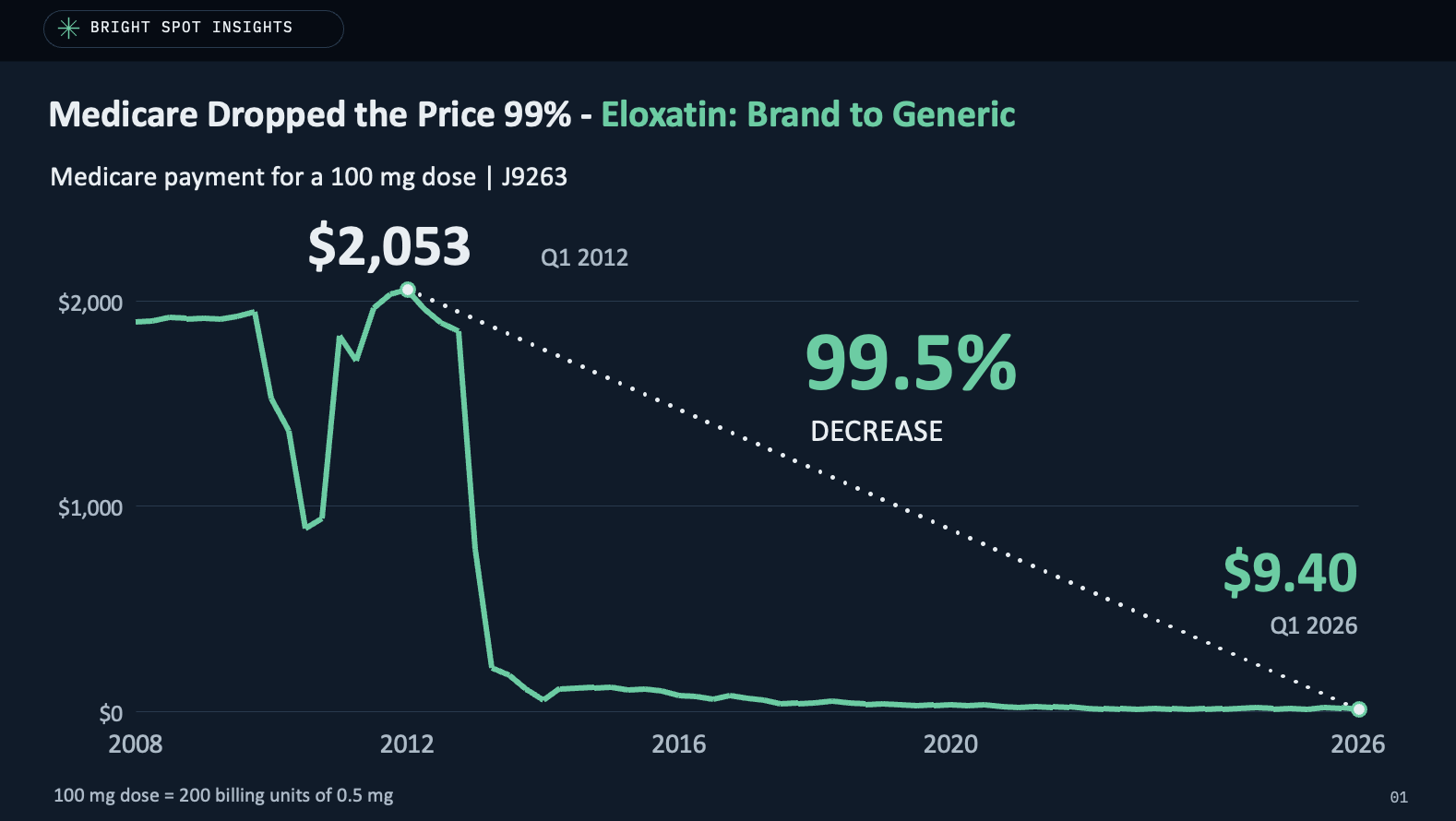
In 2012, the drug's average sales price (ASP), the benchmark Medicare uses based on what providers pay to acquire a drug, was $2,053 for a 200-milligram dose.By Q1 2026, that price had dropped to $9.40, a decline of more than 99%.
Cotter found that one hospital's publicly listed rate for the same drug was $29,595, nearly $30,000 for a treatment that Medicare would reimburse at less than $10.
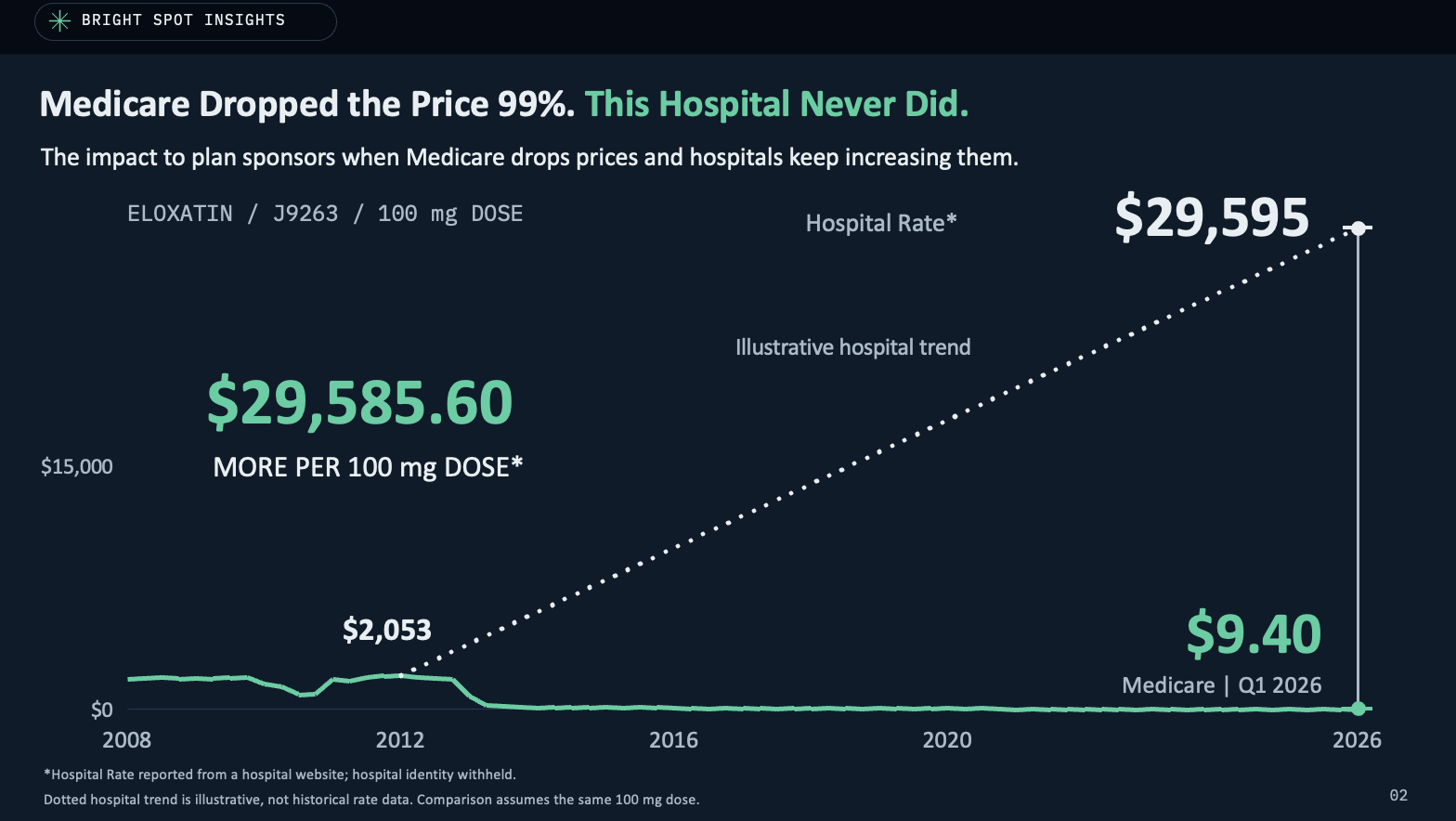
So, $30,000 versus $10 - that definitely fits in the price variability bucket."
Cotter was quick to note this is an extreme example, but the underlying pattern shows up constantly. Even at a more typical commercial reimbursement rate of 200% of Medicare, the drug should cost around $20, not tens of thousands of dollars.
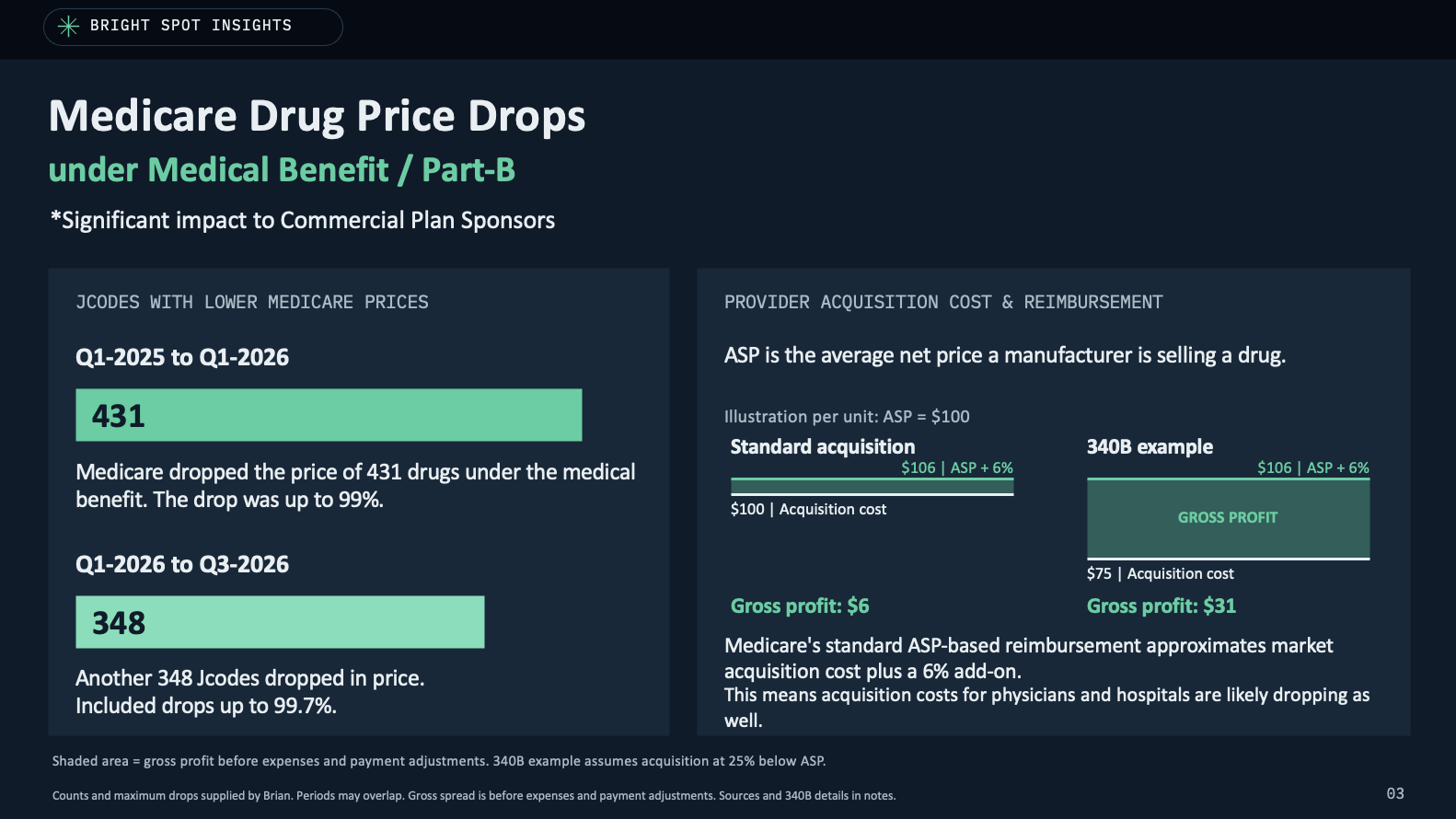
To put the broader trend in context, Cotter compared two windows of Medicare J-code data: from Q1 2025 toQ1 2026, 431 drugs billed under the medical benefit saw a price drop of up to 99%. But from Q1 2026 to Q3 2026, only eight drugs saw a price drop. Prices should, but don't fall on a predictable schedule, and providers don't always adjust their billed rates to reflect that.
How Can Plan Sponsors Identify and Act on Drug Price Variation in Their Health Plans?
Cotter's advice starts with a simple but firm rule: assume your data is wrong until you've proven otherwise.
Once the data is validated, plan sponsors can start looking for variation. If there is not much claims history to work with, such as a member with only one infusion, Cotter suggested two workarounds:
- Benchmark against Medicare to understand relative cost, even with limited claims volume
- Pull in price transparency data for the market to see what other providers are charging for the same drug
Why Direct Contracts Matter More Than Simple Redirection
It's tempting to just redirect members to a "lower-cost" provider once you spot a gap. Cotter cautioned against assuming that redirection alone guarantees savings.
"I think you have to be very careful about just redirecting patients to a provider, assuming that you're going to get a lower cost."
Instead, he recommends securing a direct contract with defined reimbursement terms. That gives plan sponsors confidence in the actual price and clarifies how often the price resets, whether annually, quarterly, or as a percentage of Medicare that changes with ASP updates.
One Employer's Creative Fix: Driving Members to Better Care
Cotter shared one of the more memorable examples from his client work: an employer that arranged transportation for members who needed chemotherapy, driving them from a local provider charging around 500% of Medicare to a high-quality medical center billing closer to 100% of Medicare.
This means every member that they're able to transport to this preferred provider, they're saving 80% on all of the chemotherapy that's going there."
Cotter emphasized that the real savings hinge on conversion. Plan sponsors can calculate the potential savings per engaged member, but none of it materializes if members don't actually use the program.
Where AI Fits, and Where It Still Falls Short
Cotter is a regular AI user, but he's learned to treat its output the same way he treats raw data: verify everything.
He described a recent experience where he asked AI to load a data set, only to notice everything was off by 6%. The tool had applied its own adjustment factor, assuming it would make the data "more reliable," without being asked to.
His takeaway: AI can help with heavy lifts like data engineering, but it isn't ready to operate on autopilot with financial data. Every output still needs human review.
The Assumptions That Could Be Costing Your Plan Money
Cotter closed the conversation with a warning about relying on assumptions instead of data. One example: it's widely assumed that a biosimilar is always cheaper than its reference drug. That's not always true.
Even though the biosimilar coming to market lowered the prices at the current time, it may be that the reference drug is significantly lower cost than the biosimilar."
He named two more common assumptions that don't always hold up: that the pharmacy benefit is always cheaper than the medical benefit, and that hospitals are always more expensive than a physician's office or home infusion. Cotter has found real-world cases running counter to each one, and he stressed that plan sponsors need continuous monitoring, not just an upfront analysis, since price scan shift after a program is already in place.
Start With the Data, Then Keep Watching It
The through line of this conversation is that price variation under the medical benefit is bigger, and more fixable, than many plan sponsors assume. Getting reliable data, validating it thoroughly, and questioning long-held assumptions can uncover savings that a standard pharmacy-only review would miss entirely.
If you're interested in learning more, check out our related content and connect with Brian on LinkedIn or explore free tools at www.brightspotinsights.com.
Related Content
- How employers can take back control of unnecessary pharmacy spending
- AH114 - How Employers Can Use Clinical Programs to Reduce Cost and Complexity, with Nash Albadarin, PharmD
- How to obtain Rx data and what to do with it
- AH030 - Plan Sponsors Need a Source of Truth; Get Your Data Now & Find It, with Jeff Hogan
- Judi Health™ Achieves FedRAMP® Ready Status, Enabling Multi-Market Growth Across Federal Healthcare Organizations

Lightly edited for clarity.
[00:22] Justin Venneri: Hello, and thank you for joining us for another episode of Astonishing Healthcare. This is Justin Venneri, your host and senior director of communications at Judi Health. And joining us in the studio today is the founder of Bright Spot Insights, Brian Cotter, whom I met via LinkedIn. Brian, thanks for joining me today.
[00:37] Brian Cotter: Hey, Justin, thanks for having me. I appreciate it.
[00:39] Justin Venneri: Okay, so meeting you via LinkedIn, what does that mean? Right, like Andrew Sang and some other guys that have come on the show through LinkedIn and their engaging posts. You're no exception there. I sort of stalked you. Kidding aside, I think the content and data you've been highlighting are pretty interesting, especially for our audience, the benefits consultants and employer plan sponsors out there. But before we jump into it, spend a minute on your background, Brian, what you do at Bright Spot Insights, how'd you get into this sort of consulting?
[01:04] Brian Cotter: Yeah. Bright Spot Insights is focused on helping plan sponsor clients really understand price variation, price variation within the services that their members are receiving, and then how to control for it. I've had the benefit of leading analytics at some phenomenal healthcare organizations and working with some really bright folks. I've taken those learnings and that experience over the past 25 years and have rolled it into looking at the data, finding opportunities that are actionable, and then working with clients on how to control these prices. My start on LinkedIn really came probably about three years ago, where I got really focused on price transparency data. It was so exciting when that data became available, but it was so difficult to work with. I love the idea of a challenge and jumped into that head first and started just posting daily on LinkedIn about the price variation that we were seeing. And again, sharing the experiences that I had at prior companies. Okay, if you see price variation in these drugs, here's some things that you can do to address that.
[02:12] Justin Venneri: Yeah, it's good stuff. I love the visuals. The charts are pretty sharp and, unfortunately, the variation's pretty stark too.
[02:18] Brian Cotter: Well, that's been honed also because I can say one of the most exciting things for me as an analyst is upfront just getting people's attention on the problem. When you see that a drug can cost 100x more at a provider, that gets people pretty excited. They tend to first question the data and the analysis. And then, once that's validated, it's the big shock of, well, is this happening to us? Oh, wait, it is happening to us. Wait, what do we do about this?
[02:44] Justin Venneri: Just based on that, there is a ton of overlap and interesting topics that we could cover. One of the things that I always think about with pharmacy spend, and what you just alluded to, is what percent of the pie is it? And when you observe these things, it's within that percent of the pie. But it's grown a lot recently. I think I saw some data recently showing specialty is now upwards of 55, 60% of pharmacy spend. Pharmacy spend overall is at least 25 to 30% of total plan spend. I think both those numbers are pretty wild based on where most of my colleagues started in the business and where you started in it. Two questions here. What's the big picture look like to you? And what are the top few priorities you see your clients wrestling with?
[03:22] Brian Cotter: Yeah, so I think the important thing that you noted there is specialty drug spend under both the medical and the pharmacy benefit. And there's interesting things that you can do on either benefit. And it's not the same things. You have to really customize what you're doing under each benefit. I tend to spend more time focusing under the medical benefit. What I've learned over time is that it seems to be there are some bigger opportunities to control spend under medical, and I've just had more experience doing that. Right. So I'm much more comfortable looking at the medical benefit, looking at the data, working through some of the issues of it being a black box, and figuring out how to identify those opportunities. Some of the stuff that I help clients focus on is looking at some of the usual suspects. There's usually common reasons why there is price variation in the drugs. So just to hit on three real quickly. Most commonly, when a drug goes from brand to generic, when there's a biosimilar that enters into a market, or when there's just market dynamics that change. Right. There's supply, there's demand changes, there's different ways and new ways that drugs are used. All of this creates volatility in the prices that plan sponsors should really understand to then design their strategy around.
[04:41] Justin Venneri: This is awesome because most of the commentary we've had on drug prices has been on the pharmacy side over the years. But as we've ventured into medical, we've heard more about Care Shift, one of our programs, and just trying to help with the med pharmacy spend and people understanding how things actually work on that side as well. And then with medical, medical benefits, like health benefits, that's another area where there's a huge, huge opportunity, we think, to address some of these cost trends or help people address the costs in their plan. On LinkedIn, when I found you, one of the posts, I mean, they involved drug prices, in particular biosimilars like you mentioned, but oncology and oncolytics as well. I think those are probably two of the higher-level issues people are dealing with. I'd love to dig in on that. To your point about variability, can you share an example or two?
[05:24] Brian Cotter: Yeah, I'd love to share an example. So one of the go-to drugs that I like to look at is this drug called Eloxatin. It also has the generic name of oxaliplatin. This one is so interesting to me because what happened that changed the price on this was so long ago. Back in 2012, this was a brand drug that converted to being a generic. At that point, the ASP price for it dropped from $2,053 for a dose of 200 milligrams to where we are in Q1, 2026, the price dropped to $9.40. That's a drop of over 99% that we've seen in this drug. It's something where you look to see, has the market reacted? It's 14 years. How has the market responded to a drug that's dropped by 99% in terms of price? And what kind of opportunities does this present?
[06:22] Justin Venneri: And ASP, the acronym there?
[06:24] Brian Cotter: Yeah. So that's the average sales price. The way I think about it is that Medicare looks at the average price that providers are acquiring this drug. Or another way to think about it is the net cost that manufacturers are selling this drug for. Right. So it's both the net cost to the manufacturer, but it's also the acquisition price that providers are paying. So when you think of ASP as ASP plus 6, that general idea is that providers reimbursed by Medicare would get 6% over the expected amount that they're acquiring the drug for. So this is a J code. If people want to look up this code in their data, it's J9263, and that'll reflect this drug, Eloxatin, otherwise known as oxaliplatin. So what I can show you, the second part of this that's really interesting, is if you look at the price decrease for this, if you then also look at what's happening with the way that this drug and the price of this drug has been handled in the market. It's all over the map. This is a real-world example that I'll go through right now. Since 2012, all the way through 2026, there are hospitals and other providers who have just continued to trend the price of this drug forward. So what we actually have in one case is that drug that was $2,053 in 2012. The rate on one hospital's website is now $29,595. Almost $30,000 for one treatment of a drug that Medicare would reimburse less than $10. So $30,000 versus $10, that definitely fits
[08:10] Justin Venneri: in the price variability bucket. I think that's a big spread.
[08:13] Brian Cotter: Yes. Now, this is an extreme example. What's important here, I think, is that the reality this can happen. This is where what I love doing for my clients is being able to look at their data. It may not be that we find this drug is up to $30,000, but maybe we find it's up to $8,000 or $12,000. It's still significantly higher than what it could be. If, let's say, they have providers paid 200% of Medicare. At 200%, this drug should still be $20. You have massive opportunities for savings when you start digging into these drugs and the price variation in the market.
[08:53] Justin Venneri: And then what can an employer do? What can a plan sponsor do about that? Once you get your data, you analyze it, you find this example or something like it. What do you do about it once you find it?
[09:02] Brian Cotter: So there's no shortage of opportunities here when you're looking at the drug side. I looked at Q1 of 2025 to Q1 of 2026, and found that for Medicare J codes, so drugs that are being billed through the medical benefit through Part B, for commercial plan sponsors, this is all their medical benefit, 431 drugs had a price drop. Those price drops were up to 99%. You then look at Q1 of 2026 to Q3 of 2026, when talking about like the first three-quarters of this year, you see 48 drugs had a price drop in the medical benefit. What can you do about this? What you can do, I think the first thing is you need to get your data. You need to get your data. The first thing I always say about data is assume it's all incorrect. You need to work through the steps to validate the data, and then you can start digging in and understanding what price variation do you see within your own data, and then you can identify opportunities. If you are seeing this price variation, one of the challenging things to do is to find that variation. If you don't have a lot of data, what if you only have someone with one infusion of a drug? Well, what you can do instead is a couple things. One is you can benchmark it to Medicare. So if you only have one infusion, you still know how expensive it is relative to Medicare. The other thing you can do is if you're looking at claims data, you can then pull in price transparency data for the market and see what is the market paying for that drug.
[10:33] Justin Venneri: And for that you use just an available benchmark?
[10:36] Brian Cotter: You can just pull in the price transparency file for a plan sponsor's specific plan. They're all required to be out there. So you then can look at other providers that you know of in that market and see their listed price for that drug.
[10:49] Justin Venneri: Oh, very interesting. And I guess this goes to the difference between med pharmacy versus PBM commercial pharmacy billed under the pharmacy benefit.
[10:57] Brian Cotter: Correct. And the critical, the most important part, I think, of all of this is, you know, as much as I'm neck deep into the data every day and running analysis for clients, I never put full trust in the data. It always has to be validated. And then I think you have to be very careful about just redirecting patients to a provider, assuming that you're going to get a lower cost. What I think is a much better approach to doing this, that I help clients with, is actually get a direct contract in place with the reimbursement terms. So then, you know, if you're redirecting a member or you have a program in place or incentives in place to drive members to lower-cost providers through those direct contracts, you have confidence that it's going to be lower cost.
[11:44] Justin Venneri: In addition to direct contracting, what's one or two other creative things that you've seen employers do or try with their health plan or their benefit design once they get their data and they realize some of these issues they have?
[11:56] Brian Cotter: One of the things I've seen done that is incredibly creative, and it's also been phenomenal for getting members to lower-cost providers, because that's always like the challenge. You find the opportunity, and then the question always is, is it actionable, and how do we do something about it? What I've seen one client do, and the engagement around this is phenomenal, they're actually providing the transportation. That is, it's putting members in cars that need chemotherapy and driving them to the lower-cost, higher-quality provider to receive their treatment. In this scenario, the local options that these patients were going to previously had the chemotherapy prices around 500% and above Medicare, where they're now being transported to is a phenomenal medical center. It's very high quality, and the price is around 100% of Medicare. Right. So this means every member that they're able to transport to this preferred provider, they're saving 80% on all of the chemotherapy that's going there.
[13:05] Justin Venneri: That's amazing. It's always interesting to me that something like that, it seems like it's more involved, putting somebody in a car or taking them somewhere else. But the ROI on it seems pretty clear when there's that big of a gap in cost.
[13:17] Brian Cotter: Yeah. And it's a great thing for people to assess. If you look at the price variation, you can very quickly estimate what your savings opportunity is going to be per engaged member. Right. You can look at what are you paying today through maybe some higher-cost providers. What could you be paying for some lower-cost, high-quality providers? And then the other magic piece in there is how many of those members do you think you're going to convert? And the conversion strategy is so critically important to this, because you can do the analysis, you can put some incentives in place. If your members don't respond to those incentives and engage in the program, then you're never going to have savings.
[13:58] Justin Venneri: I have a question, just a couple more questions for you, Brian. This is super interesting. We used to say, and AJ says it all the time, Josh has said it, we've observed historically drug prices changing just kind of twice a year. Rule of thumb, you know, January 1st and then mid-year, maybe some adjustments. And those are some pretty big decreases you noted. And we've seen generic deflation over time. Price changes that you see, are you seeing that happen where it's, you know, you're seeing the list price increase or otherwise? But what about between the benefits, the pharmacy benefit on one side, the medical benefit on the other? Is it always the case that there's quote-unquote disagreement there? How do you see movement between where the drug sits in the benefit plan?
[14:35] Brian Cotter: Yeah, this timing piece is incredibly interesting. On the medical side, if you're looking at comparing to ASP, Medicare puts out new rates quarterly, but that's only the Medicare rate. That doesn't mean, as a commercial plan sponsor, that's what you're getting through your providers. You then have to look at the data to get a sense of how frequently do those commercial contracts then change. Some will be designed where the prices being paid for drugs on their medical side only change once a year. Other ones may not even change once a year. Other commercial contracts will be a lot more fluid and may change every quarter. Right. So it's an interesting thing that you need to look for and understand. And that's also another important point as to why you want a direct contract. Because you can put the terms in there as to when do the prices reset, do you have just a percent of Medicare there that then flows with the quarterly changes, or do you try to create something that's a little bit more stable where you only have price changes once a year?
[15:39] Justin Venneri: Easier data, getting data. I'm just curious. This has come up a lot recently as well. The importance of getting your data, using it. Is it getting easier to get the data, or is there still a lot of friction there? I would hope it's getting better by now.
[15:50] Brian Cotter: You know, I think data is just a huge challenge, and I think the journey is only starting once you get the data. Getting the data is something that you have to think about when you're contracting with either the health plan or the PBM. You have to make sure that is addressed up front with very clear, very direct terms and requirements there. And still it could be a challenge after that. Once you get the data, what my philosophy always is: assume the data is incorrect until proven otherwise. So you then need to do the work to figure out, can you trust what you received? And not only can you trust the prices that are in there, but can you trust that the content is complete? So are you getting a complete data set? Are you getting all of the elements that are needed? Are you getting everything so that you can then build strategies around looking at things like price variation? So I do think getting data is absolutely critical. I do think there's been a series of steps that you have to go through and should go through before you have a level of trust in that data.
[16:54] Justin Venneri: Yeah, you'd love to be able to trust your data implicitly. Right. But if you have trouble getting it, there's probably a reason there.
[17:01] Brian Cotter: There's not. I would put that out there for every data, whether it's transparency data, whether it's claims data, whether it's pharmacy data, whether it's reference data, benchmark data. Start from a place of it's incorrect until proven otherwise. And there should be a process that helps you build confidence in each one of those pieces. I can't tell you how many times I've looked at analysis and literally every reference data set, every data set in the analysis was incorrect to some level. So it's just challenging. Healthcare data is a really difficult nut to crack. And there's a lot of things you can do, but there's also a lot of things you have to navigate around.
[17:38] Justin Venneri: The sort of work, the analysis of the data, the consulting. I'm just curious, today, 2026, compared to two, three years ago, how's that changing? Is it becoming... it seems like the end market is becoming smarter about the issues. They're starting to dig in. They're setting up their processes per CAA 2021 and 2026 to evaluate things and make sure that what they're paying is more reasonable. How do you see things evolving?
[18:03] Brian Cotter: So a couple things. I love the idea that price transparency data has come to market. That was something that I think many of us thought would never happen. I think it's a good thing that we've started and the industry has gotten transparency data. But we're only at like the very beginning stages. I think a lot more has to be done to build credibility and trust around that data that then makes it more dependable and usable for folks that want to tap into it. I also think things like AI coming in has really helped a lot with some of the data engineering challenges of working with these massive data sets. So we're getting access to better things like transparency data. We're getting better help with working with these massive data sets. The one thing that has still not changed, and this goes back not even two or three years, it goes back to like the beginning of the first data set, is you can't overemphasize the importance of building trust and credibility in the data. What we're seeing is more and more data becoming available and more ways to bring the data in. What makes me most concerned about that is assuming that whatever data set, again, that you're working with is credible and not doing the work to validate it. You're just kind of pushing it into whatever tool you're working with and say, give me a great answer. But it can't give you a great answer if you're not feeding in good data.
[19:25] Justin Venneri: You know, it's interesting that you bring up AI in that context, because we always talk about having good data, and the data could be words, PDFs, contracts, actual data, kind of make sure that you have your data set organized, structured properly, and then you try to keep the AI on the rails, so to speak. So I think it's going to be really interesting to see how people evolve the use of AI with these data sets as they validate them for themselves. Of course. And then you can try to deploy tools that work on your validated data. And hopefully you don't have an AI tool that's helping you that hallucinates and just starts making stuff up.
[19:56] Brian Cotter: I've seen some wild stuff. I love AI. I use AI all the time. I've come to learn, just like the data, you really have to dig in and validate everything it does. I can tell you just a quick example. A few weeks ago, I had AI load a data set for me, and I was reviewing the data. I'm like, why is everything off by 6%? This just looks weird. And the AI decided to apply a factor on it to increase it by 6% because it thought that the data needed to be enhanced with that, and that that would make it a better, more reliable number. I'm like, where was that discussed? Where did we decide this? With anything, and especially with like handling data and AI, I don't think AI is really at a place, especially with this data and analysis, where it's kind of like a one-prompt situation. I think it can help with some specific big lifts. But you still have to do the validation, you have to do the review. You have to make sure it didn't get overly creative with something that it wanted to do that you didn't ask.
[20:57] Justin Venneri: Yeah, it's not quite a Terminator moment, but I could see you kind of being annoyed with your bot there. So, last question for you, Brian. Thanks so much for taking the time. It's been great chatting with you. And please keep your compliance hat on for this one. I know you've seen a lot over the years. What's the most astonishing thing related to our discussion today that's safe to share? Send us off with a good or interesting story.
[21:15] Brian Cotter: Yeah, I don't know how exciting this will be, but the thing that I'm always careful about, and the thing that always makes me kind of tense and kind of brace myself, is just the idea of using assumptions to make decisions. I think it's such a dangerous thing, and I understand there's a need to move quickly and get decisions made. What I think is kind of most concerning is the idea of trying to make big decisions without data behind it to support. For example, there's assumptions out there. I'll just put one out right now. It's the idea that a biosimilar is always going to be lower cost than the reference drug. I think what's been good is that introducing biosimilars has dropped the cost of that drug, the reference drug, and has benefited the patient and dropped prices. But that doesn't mean that where things currently are, that the biosimilar is currently the lowest-cost option. Even though the biosimilar came to market lower and lowered the prices at the current time, it may be that the reference drug is significantly lower cost than the biosimilar. It's really important that the analysis be done that determines how best to create these incentives, design these programs, so it follows the plan sponsor's specific prices and what's in place. And not only is it important to do it upfront to design the program, it's critically important to continue monitoring those prices once a program is in place. So you can avoid the rug pull. The prices all of a sudden change. And that goes against the way we're incentivizing patients. Well, now we need to modify and update the program.
[22:55] Justin Venneri: I guess that's where clear communication and ability to see that change helps a lot. Because then you could, if I hear you right, and if I understand, then you could at least say, wow, we noticed a big price change here. We can communicate to the member effectively that maybe we need to adjust. This is what they need, but maybe we need to adjust it somehow so they go to a different site of care or some other way to obtain that medication, so that way they can continue their treatment and stay adherent.
[23:19] Brian Cotter: Exactly. And this happens across so many different things. You know, I'll say there's assumptions around biosimilars always being lower cost. There's assumptions about the pharmacy benefit always being lower cost than medical. There's assumptions about hospitals always being higher cost than physician office or home and field. Each of those examples, or each of those cases, I have found cases that have gone the opposite direction. And it's not just one-offs. I think there's a lot more going in the opposite direction of assumptions than what is generally understood. And that again is critical, where the analysis is needed.
[23:55] Justin Venneri: Brian, thank you so much for sharing some of your experience and some examples of what you're seeing so people can think about this. I think it's an awesome discussion. I'll drop some links in the show notes, of course. Tell everybody, what's the best way to get in touch with you should they hit you on LinkedIn like I did?
[24:08] Brian Cotter: Yeah, hit me on LinkedIn. Come see me on LinkedIn. I try to post weekly there. Or the other option is check out my website, www.brightspotinsights.com, where I tend to post a lot of tools out there, free tools that let people get deeper into these areas and find some opportunities for savings.
[24:26] Justin Venneri: Very cool. All right, Brian, thanks so much for joining us. Hope you have a great rest of your day, and I look forward to staying in touch.
[24:30] Brian Cotter: Awesome. Thanks, Justin.

.webp)
.webp)
.webp)