AH119 - "You Belong in Every Room": 2026 Women Pharmacist Day Roundtable


.webp)


Episode 119 Highlights
- There is no single path through pharmacy: Careers can span retail, managed care, education, clinical consulting, operations, and roles that graduates may not yet know exist.
- Mentors can redirect a career: Personal stories show how sustained encouragement, honest feedback, and advocacy can create opportunities after an internship or an unexpected setback.
- Setbacks can become turning points; progress matters more than perfection: Missing a residency match, facing problems without a clear answer, and navigating uncertainty can build resilience and open new directions. Giving yourself grace, learning from mistakes, and protecting against burnout are essential parts of long-term growth.
- Confidence is a skill that everyone can develop: Networking, communication, presenting, and getting comfortable with discomfort help pharmacists contribute in unfamiliar rooms.
- AI extends, not replaces, human expertise: Technology and unified data can strengthen adherence outreach and connect people with relevant programs, but clinical judgment and creativity remain central.
- Community creates lasting impact: Mentorship and professional networks help women pharmacists exchange knowledge, build confidence, and support the next generation.
"You Belong in Every Room": 2026 Women Pharmacist Day Roundtable
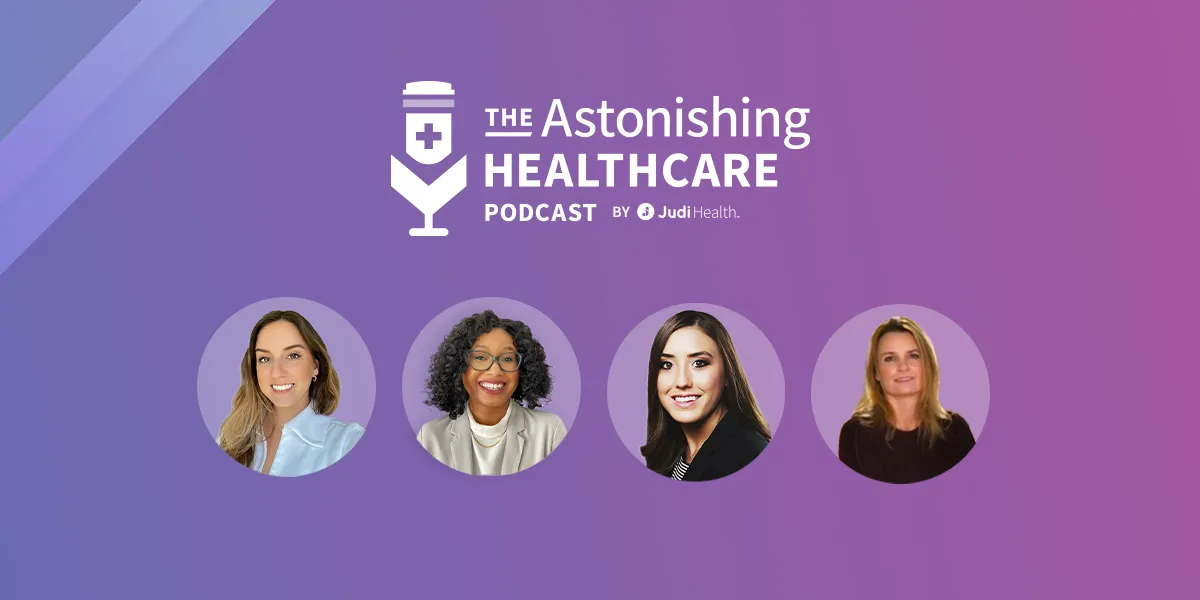
Women Pharmacist Day falls on October 12th each year, and for this year's special Women Pharmacist Day episode of the Astonishing Healthcare Podcast, we've added a twist: a special guest host! For Episode 119, Hope Nakazato, PharmD, moves from the hot seat (Episode 50) to take the reins and lead a candid conversation about the experiences, relationships, and unexpected turns that shaped the careers of four women pharmacists at Judi Health:
- Debra Carlson, PharmD, Formulary Operations Manager
- Ayesha Wafeeg, PharmD, Senior Manager of Appeals
- Avni Doshi, PharmD, Clinical Account Consultant
- Bonnie Hui-Callahan, PharmD, VP of Clinical Programs
The conversation covered mentors who opened doors, career advice for students, stories about defining setbacks, and the role women pharmacists play in AI and innovation. If you're a pharmacy student, an early-career pharmacist, or a leader who mentors either, this discussion offers a candid look at how pharmacy careers actually unfold.
- Debra is originally from the Chicagoland area. She attended Midwestern University, completed a residency at a health plan, and led a regional health plan in Central Illinois. Judi Health is her first big PBM role.
- Ayesha started in retail, did some long-term care work, and then joined OptumRx, moving from mail order into prior authorization and appeals, where she grew into leadership. She attended Xavier University of Louisiana and has been a pharmacist for about 18 years.
- Avni is based in Austin, Texas, where she attended the University of Texas. She previously worked in hospital pharmacy and in formulary management at a small boutique consulting company.
- Bonnie attended the University of Southern California for undergrad and pharmacy school. She spent about four years in retail with Kroger, four years at OptumRx in clinical programs, and three years in pharmacy education before joining Judi Health about five years ago.
What Women Pharmacist Day Means
Hope opened with a brief history lesson. The October 12th date honors Elizabeth Gooking Greenleaf, recognized as the first female pharmacist in the United States, who also raised 12 children. Then she shared the figure that frames the entire episode:
I think it's astonishing that women represented about 8% of the pharmacy workforce in the 1960s, and now we're up to about 70% female representation as we sit here today."
For Debra, the day is about recognizing the women who paved the way and those still making a difference. She noted that her own pharmacy school class was majority women, "so it's amazing to see how far the profession has come."
Pharmacist Mentorship
Ayesha credited Rosa Jordan, PharmD, her preceptor during a summer Rite Aid internship in Mobile, Alabama, after her first year of pharmacy school. Rosa "really took me under her wing and challenged me daily," and she stayed in touch after Ayesha returned to New Orleans for school. Today, Ayesha pays it forward through LinkedIn. She admitted she wasn't very responsive at first. Now she guides people, helps with resumes, and shares information about the PBM space.
Bonnie's story began with a moment many pharmacy students dread: she didn't match for residency in her fourth year. "I was devastated," she recalled, with graduation about six weeks away and no plan. She reached out to Linh Lee, PharmD, who she knew through student leadership and APhA. Linh's answer: "You know what? I'm going to find a role for you. I'm going to create something. I believe in you."
Bonnie now takes on students and residents who come through the Judi Health program. She focuses on the soft skills that rarely get taught, including how to network and how to "walk into rooms where you feel like you don't belong and speak with confidence."
Stay Curious and Expect Detours
Why does career advice matter so much here? Hope admitted she wished she'd known in school that there's "a whole world beyond community pharmacy or pursuing a residency and becoming a clinical hospital pharmacist. Avni's best advice was to stay open to opportunities, even ones outside your expected path.
When I graduated from pharmacy school, I didn't even know my current role existed," she said. She encouraged staying curious about other sectors and staying connected with former classmates.
Progress over perfection
Bonnie offered advice. First, to accept that your path won't be linear. She also described growing up in an environment where only A's were acceptable, and breaking that mindset is what allowed her to get where she is today.
It's okay not to be perfect; we just have to do what we can in the moment and keep making progress."
The Challenges That Shaped Them
Hope then asked the panel to name the challenge that shaped them most as pharmacists and leaders.
Bonnie returned to her residency story. During her first year working, she applied again: "I'm proud of myself for doing that. Not many people do." That year let her network with residency directors and apply to programs that matched her true passion, rather than applying "because I thought I should." Her message to students who didn't match: don't be discouraged, keep trying.
Hope called it "a true testament to what Women Pharmacist Day is about," tying it to perseverance and to how quickly teams respond when things aren't perfect.
Avni's challenge was the shift from student to professional. School trains you on exams with one answer, "But sometimes you have to create the solutions yourself." That problem-solving and collaboration is now what she enjoys most. Hope named collaboration as another core theme, encouraging pharmacists not to be afraid to ask for help.
The Perfectionism Trap
Ayesha pointed to work-life balance. The drive to be perfect in a new role or leadership position can lead to long hours and burnout. Her turning point was a change in self-talk:
Yes, you're going to make some mistakes. Not everything is urgent. Take your time, develop a schedule, and find that work-life balance so you don't burn yourself out."
Women Pharmacists Driving AI and Innovation
Hope observed that there isn't a playbook for the industry today, with new medications, never-before-seen therapies, and AI all arriving at once. How are women driving that change?
Bonnie shared a concrete example. While reviewing adherence program data with a woman pharmacist on her team, they presented a business plan to Judi Health's in-house AI team. The team is now adding AI calls as an additional intervention to remind members to refill chronic medications.
She also described looking at using Judi to identify members who may benefit from vendor partner programs. Because Judi processes both medical and pharmacy claims, "we have that data at our fingertips."
Avni uses technology daily to identify trends and understand utilization, but she stressed a limit:
We still need the human, clinical element to translate all that technology into something meaningful."
She noted that pharmacists at Judi Health work across clinical, technology, analytics, client services, and formulary roles. Hope added that women are well positioned to be good prompt engineers. Debra agreed that AI's opportunities are "almost limitless" with that human piece in place, and she pointed to women creating unique roles for themselves and to more women engineers in pharma R&D.
Hopes for the Next Generation
Debra is most impressed by women juggling "a million things outside of work" while building careers. She hopes future generations don't let "any barrier, self-doubt, or fear" stop them. Avni pointed to the limitless opportunities and the willingness of women pharmacists to share knowledge: "it's an exciting time, so stay open."
Bonnie gave a shout-out to Suzanne Soliman, PharmD, and Pharmacist Moms on the origins of Women Pharmacist Day. "When you put a group of women together, we really are unstoppable," Bonnie said.
Ayesha closed the conversation, urging the next generation to step into their roles with confidence:
I want them to know they belong in every room."

Lightly edited for clarity.
[00:22] Justin Venneri: Hello, and thanks for listening to another episode of Astonishing Healthcare. This is Justin Venneri. However, I won't be your host today. I'm just doing a quick intro for this special Women Pharmacist Day 2026 episode, and I'm super excited to introduce my pharmacist and commercial team member colleague, whom I love working with on content and learn a ton from every time we chat. She's been a past guest on the show a couple of times, actually: Episode 50 on addressing the fear of change, which was insightful for sure, and then last year's Women Pharmacist Day episode as a panel member. It's none other than Hope Nakazato, who's going to take the reins from here.
[00:54] Hope Nakazato, PharmD: Thanks, Justin. Very excited to be back in the studio here today and looking forward to leading this discussion with our wonderful team of women pharmacist colleagues to talk about what this day means and to share some of our experiences and insights. But before we get into that, let's do a round of introductions to introduce our team members here. Debra Carlson, who's one of our formulary operations managers, would you like to go first? Spend a minute on your background, where you went to school, and your path to Judi Health.
[01:20] Debra Carlson, PharmD: Sure. Thanks so much, Hope. Super happy to be on the podcast. As you said, my name is Debra Carlson. I'm on the formulary operations team here at Judi. I'm actually originally from Chicagoland, Illinois, so I went to Midwestern University for pharmacy school there and have been a little bit all over the place since then. I did residency at a health plan. I also led a regional health plan in Central Illinois, so mainly a health plan background. And this is my first kind of big PBM role at Judi, so I'm super happy to be here.
[01:52] Hope Nakazato, PharmD: Great. Thanks so much for joining us today. And then we have Ayesha, senior manager on the utilization management team. Would you like to go next?
[01:59] Ayesha Wafeeg, PharmD: Yes, thank you, Hope. As Hope stated, my name is Ayesha Wafeeg. I'm the senior manager of appeals here at Judi Health. I started my career in retail, like a lot of pharmacists, and then I did a little long-term care. Then I was given an opportunity to work for a larger PBM, OptumRx, where I started in their mail order division and then transitioned over to prior authorization and appeals, where I've stayed in that space and just grown into leadership. I attended Xavier University of Louisiana, and I've been a pharmacist now for about 18 years.
[02:36] Hope Nakazato, PharmD: Great. Thanks so much, Ayesha. And Avni Doshi, one of our clinical account consultants, you're up.
[02:42] Avni Doshi, PharmD: Thanks, Hope. Hi, everyone. I'm Avni Doshi, clinical account consultant on our client services team here. A little bit about me: I'm based out of Austin, Texas. I actually went to pharmacy school here at the University of Texas, liked it well enough, and stayed. Prior to my role at Judi Health, I worked a little bit in hospital pharmacy and also on formulary management at a small boutique consulting company. So I'm very excited to be here with you all today and share my experiences.
[03:11] Hope Nakazato, PharmD: Awesome. And last but not least, we're excited to have with us Bonnie Hui-Callahan, our VP of clinical programs. What's your alma mater? And we want to hear a little bit more about your role here at Judi Health.
[03:22] Bonnie Hui-Callahan, PharmD: Yes, absolutely. Thanks, Hope. My name is Bonnie Hui-Callahan, and I'm VP of clinical programs. My alma mater is the University of Southern California, where I went for undergrad as well as pharmacy school. I've been a pharmacist for about 16 years, based in Southern California. I spent some time in the Midwest and started my career off similar to some of us here in the room: retail pharmacy with the Kroger company for about four years. Then I switched to OptumRx for another four years, where I actually started my journey in clinical programs. Before coming to Judi Health, I spent about three years in pharmacy education. I've been with Judi Health for about five years now. My team of pharmacists and technicians owns and operates the suite of clinical programs, including ancillary services, that we offer to our downstream clients. Great to be here.
[04:06] Hope Nakazato, PharmD: Now we're going to get to the questions, the fun part of the show. We're excited to hear everyone's diverse experiences and responses. We're going to start with the title of the episode: What does Women Pharmacist Day mean to you? I'm going to kick it off with a little bit of a history lesson. We celebrate Women Pharmacist Day on October 12th. I did a little bit of research, and it was actually chosen to honor Elizabeth Gooking Greenleaf, who's recognized as the first female pharmacist in the United States. So, very exciting. She also raised 12 children. That's 12! That's a crazy achievement right there in and of itself. I think it's also astonishing that women represented about 8% of the workforce in the 1960s, and now we're up to about 70% female representation as we sit here today.
So as we move forward, it's really important that we continue to progress the career, continue to learn from one another, and I look forward to hearing everyone's experiences. I'll kick it back to Debra. What does Women Pharmacist Day mean to you?
[05:08] Debra Carlson, PharmD: Yeah, thanks, Hope. Like you said, there's a lot of really interesting history behind Women Pharmacist Day and women in the field. For me, Women Pharmacist Day is really a day to celebrate the women in pharmacy who paved the way for all of us on the call and for future generations, and to recognize those who continue to make a difference in our field today. I'm really proud to be in a profession where women continue to break barriers and are represented at all levels of leadership. My pharmacy school class was majority women, so it's just crazy to see how far the profession has come.
[05:43] Hope Nakazato, PharmD: It's crazy. And I feel like even from the time I graduated pharmacy school to now, I've seen so much development within the profession, as well as advancements in the different medications we all have access to. It's an exciting time to be in pharmacy, for sure. The next question I have is really two questions in one. The first part is: Who has been the most influential mentor in your career? And second, can you share a story about how you pay mentorship forward? I think that's a really important part of how we all continue to make each other better in our careers and in life. We're going to start with Ayesha.
[06:18] Ayesha Wafeeg, PharmD: Yeah. The most influential mentor I had was a pharmacist named Rosa Jordan, PharmD. When I'd just completed my first year of pharmacy school, I did a summer internship with Rite Aid, and she was my preceptor. She really took me under her wing. She challenged me daily. She was the pharmacy manager at her store. And even after I completed that internship, which was in Mobile, Alabama, and I went back to New Orleans for school, she kept in touch. She made sure that if I needed anything, she was there. I really appreciated her. As for how I try to pay mentorship forward, a lot of people reach out to me on LinkedIn. At first I wasn't responsive, but now I see how important it is to help others who want to grow and learn more about different paths in pharmacy. So I'm always open to conversations, guiding them, helping them with their resumes, and giving them information about the PBM space.
[07:12] Hope Nakazato, PharmD: That's a great story, and I hope Rosa is listening to this episode somewhere. Next up, we have Bonnie, one of our wonderful internal leaders.
[07:20] Bonnie Hui-Callahan, PharmD: Yes, mentorship is so important. If I think back on one of the most influential mentors for me, it would be a pharmacist named Linh Lee, PharmD. She was my first boss out of pharmacy school. Why that's especially significant is that in my fourth year, as we all know, many of us apply to residency. Match Day comes, you open the email, and some people are happy and some aren't. For me, I didn't match my first year. I can go into this more in the next part of the conversation, but I was devastated. I'd put all my eggs in that basket, and that was my next step. I thought, "Well, I don't know what to do now. I graduate in six weeks, and I have no plan." So I reached out to Lynn, whom I'd known through leadership positions during school. I was very involved with APhA in particular. And she said, "You know what? I'm going to find a role for you. I'm going to create something. I believe in you." She essentially created a job for me fresh out of pharmacy school simply because she believed in my experience and in who I was after getting to know me over four years of pharmacy school. That meant so much to me, not only because I now had something to step into, but because someone would go so far as to create something for me because they believed in me. That was huge.
As far as giving back in a mentorship capacity, I'm now involved with taking on students and the residents who come through the Judi Health program, because that's so important. It was for me. I eventually did residency the following year, and it was so important for my development, not just in experience as a pharmacist, but in my confidence level and soft skills: How do you talk to people? How do you network? How do you walk into rooms you feel like you don't belong in and speak with confidence? So many of those soft skills are important to learn, and we don't get a lot of that in school or even in our everyday jobs. So I make an effort to add that piece when students and residents rotate in with us.
[09:13] Hope Nakazato, PharmD: That's wonderful advice, Bonnie. I'd give a plus-one to that. Soft skills are so important, and that's something I emphasize when students rotate through: working on your soft skills, presentations, and speaking in general, and building that internal confidence. I think in general, it's something we as women can all benefit from: getting in front of a room, starting to believe in yourself, taking on more questions, and building a level of confidence that matches our underlying skill sets and knowledge base. So I love that advice, and it's wonderful that you learned it from a mentor. Debra, anything you'd add to the discussion?
[09:45] Debra Carlson, PharmD: Yeah, I'll say I've had a lot of mentor-like relationships in my career, and seeing someone succeed and do something they're proud of has always been so inspiring. Having that team that's going to celebrate your successes and lift you up matters, and I've always been so appreciative of anyone who's taken time out of their career to do that for me. As far as paying mentorship forward, as Bonnie mentioned, we precept students and we have residents, and I love precepting. Whenever we get students here at Judi, that's always a highlight of my day. Outside of pharmacy, I also participate in an organization called Junior Achievement. It's a nationwide nonprofit focused on career exploration and preparing students for life after school, and that's been really rewarding to be a part of.
[10:29] Hope Nakazato, PharmD: Awesome. And this is actually a great transition, because I'm hearing a lot about students, and this is something I really wish I'd known in pharmacy school. I didn't know there was a land beyond community pharmacy, or pursuing a residency and becoming a clinical hospital pharmacist. So, students, if you're out there listening, I think this next question will be especially interesting to you. We're going to kick it to Avni. What about career advice? Can you share the best advice you've received thus far in your career as a pharmacist?
[11:01] Avni Doshi, PharmD: Yeah, absolutely. I think this is such a great transition, because one of the best pieces of advice I received is to be open to opportunities, even if they don't fit exactly what you think your career path is going to be. When I graduated from pharmacy school, I didn't even know my current role existed. So being open and very curious about what's going on, not only in your sector of pharmacy but also with what your former classmates are doing, and staying connected, is probably some of the best advice I ever got. You never know where your career will take you and how the skill sets you learn will be transferable in different ways.
[11:44] Hope Nakazato, PharmD: That's great advice. If opportunities come up, I think it's great to be open-minded and take a chance on something new. And to Avni's point, a lot of us here at Judi didn't realize our current roles even existed. At least when I was in pharmacy school, I couldn't have dreamed this up. Bonnie, I know you touched on great career advice, but I'd love to hear more from you.
[12:08] Bonnie Hui-Callahan, PharmD: Yeah, absolutely. I completely agree with your advice, Avni. I'd add that in pharmacy, we're so fortunate to have so many different paths we can take. And I know in pharmacy school, we don't really learn a lot about that.
[12:21] Ayesha Wafeeg, PharmD: Right.
[12:21] Bonnie Hui-Callahan, PharmD: Coming out, it's like, "Okay, you have hospital, and you have retail." There are two options. Then you eventually get out and realize, "Wait a minute, there's much more than that." In fact, there's more being created as we speak. It's so exciting to be in a career that allows for that. So career-advice-wise, I'd say really two things. One is to be okay with the fact that your career path isn't going to be linear. I thought I was going to graduate and be an ambulatory care pharmacist. Then I went into retail, then managed care, then did some time in education. And in each role, I take my prior experiences and bring all those transferable skills to the next one. What I tell my students is that all experience is good experience. Take it with you. Show it in the interview, show that you can use it, and show that you're able to do that next job. So that's the first thing: Your career path isn't linear.
The second is to be okay with progress over perfection. I know many of us have heard that before, but especially working here at Judi Health, we move so quickly and create such great things, and the only way we can do that is because we're not sitting and waiting for things to be perfect. We're not waiting to know all the facts to make the perfect decision. It's okay not to be perfect, but we've got to do what we can in the moment and keep making progress. I grew up in an environment where you could only get A's. A is perfect: perfect, perfect, perfect. That's all you can be and do. I had to really break that mindset and say, "No, I can't always be perfect, and that's okay." That's allowed me to get where I am today, because I wasn't perfect, but I learned from it and kept moving forward. I'd say that to a lot of students who may be afraid to take that next step because they don't feel good enough. I want students to know that shouldn't be the case. Just keep moving forward.
[13:58] Hope Nakazato, PharmD: I love that. And that's actually a perfect transition to our next question on progress over perfection. I'm sure we've all had to overcome barriers in our careers thus far, and to the point about careers not being linear, maybe the path we've had to take isn't the one we imagined for ourselves, but we've made the best of it. If anything, maybe we've come out better than we could have imagined. So this is a question about challenges: Is there a challenge that has shaped you the most as a pharmacist and a leader, or something you're particularly proud of in your career that you'd like to share? I'll bounce it back to Bonnie, because I think there was more you wanted to share about your career not being linear, and then we can move on to the rest of the group.
[14:40] Avni Doshi, PharmD: Sure.
[14:40] Bonnie Hui-Callahan, PharmD: Yeah. Earlier I mentioned that I didn't match for residency as a fourth-year student. I'd say that was probably the biggest challenge in my career, especially early on. Even now, when I think about questions like this, that's what comes up for me. As challenging as it was at the time, I'm grateful it happened, because it forced me to figure things out. It forced me to have hard conversations with people who helped pave that next step for me. Then, during that year when I was working, I decided to apply again, and I'm proud of myself for doing that. Not many people do. That first year out, I was able to network with a lot of residency directors and get a better sense of what I really wanted to do. So I ended up applying for residencies that truly matched my passion, whereas the year prior, I was just doing it because I thought I should. The following year gave me the experience to know what I actually wanted to do. So I went into those interviews, and it was very evident to both me and the people interviewing me that this was actually what I wanted. In a lot of interviews, that confidence and passion speak louder than words. I think that's ultimately what helped me land that residency.
From there, it was a lot of networking and seeing what cool projects came up and what cool people I met, which led to my next job, and so on from there. I'll say all my jobs have come from someone I knew. Looking around this room, I'd think that's the case for a lot of us. That's also invaluable: Don't underestimate the opportunity to meet new people and see how you can help each other out. That was a long-winded answer, but I'd say to those out there who may not have matched for a residency: Don't be discouraged. Please keep trying, whether that means applying again or going into the workforce and seeing what opportunities come from there. Again, pharmacy is a world where you can have a successful career either way, as long as you push forward.
[16:36] Hope Nakazato, PharmD: That story is such a true testament to Women Pharmacist Day: the perseverance we've all had to show in getting back up and realigning with something we knew was our path all along. I think that's something we do especially well here as a company. We don't always get it perfect, but I always tell the teams it's about how we respond and how quickly we respond. So I love the perseverance theme. Avni, I'm curious whether you've had any challenges and what your response is.
[17:04] Avni Doshi, PharmD: Yeah, I'd love to share. One of the biggest challenges for me in transitioning from being a student to being in the workforce was learning how to navigate situations where there wasn't a clear answer readily available. We build a really strong foundation in our training. We take a lot of exams where there's one answer, or maybe a couple of correct "select all that apply" answers. But sometimes you have to create the solutions yourself. That's one of the things I really enjoy about my day-to-day: the problem-solving, and learning how to get to a solution. It might not be the best solution, but it's a solution at the time that can help others. Whatever that looks like, it means leveraging resources, collaborating with others, and thinking through the best way to solve a problem at the time, taking a creative, stepwise approach and working together to help individuals. Making that mindset shift when entering the workforce was a bit of a challenge, but it's something I do on a daily basis.
[18:14] Hope Nakazato, PharmD: That brings up another great theme for our Women Pharmacist Day: collaboration. That's been such a strong pillar of my own internal compass. It's so easy to just pick up the phone and phone a friend, so to speak, and everyone is so collaborative. I think as a network, we can all continue to get better at collaborating, sharing experiences, and not being afraid to ask for help if we need it. So that's wonderful. Avni, thank you so much for sharing. Ayesha, anything you'd add to the challenges question?
[18:45] Ayesha Wafeeg, PharmD: Yes, definitely. One big challenge for me was developing a work-life balance. I know a lot of us struggle with that, and as Bonnie mentioned, we try to be perfectionists. We get a new role or step into leadership, and we just want to be perfect. We want to make sure we're doing our job right, so we work extended hours, continue down that path, and might end up with burnout. For me, it was finally stepping back and saying, "Yes, you're going to make some mistakes. Not everything is urgent. Take your time, develop a schedule, and find that work-life balance so you don't burn yourself out."
[19:20] Hope Nakazato, PharmD: That's such an important part of showing up every day as the best version of yourself, so you can be there for your teams and, ultimately, for our members and patients. Thank you for adding that to the discussion. Now we're hopping in a time machine and going back to when you were in pharmacy school, or a younger version of yourself. This ties together almost every question and theme we've covered so far: What would you tell your younger pharmacist self if you could go back in time? It could be anything about career path or growth, or maybe just a little validation that it's going to be okay if certain things don't work out. Ayesha, since you were just up, what's your advice to your younger self?
[20:00] Ayesha Wafeeg, PharmD: I definitely wish I'd had Avni and Bonnie to speak with about career advice, because I'd tell myself not to feel confined to traditional paths. My school did tell us about residency and medical affairs, but they didn't push it on us. So I thought, "Oh, okay, I'll go to retail. There's my job. I'm fine." I'd tell myself: Reach beyond. Ask for support, get all the training, do the residency, and don't be afraid.
[20:27] Hope Nakazato, PharmD: So many of us think there's one standard approach to success. Understanding that not all success looks the same, and that there isn't a linear path to getting there, is such great advice. What about you, Avni?
[20:40] Avni Doshi, PharmD: Yeah, this is a really fun question to think through. I'd go back and tell myself to stop trying to have everything figured out. It's very easy, especially for us as women, to think that once we finish school, we have to have the career path figured out, have our personal life figured out, and have everything aligned. I've learned, and continue to learn daily, that it really is a journey, and you're going to be constantly learning throughout your career. So give yourself a little grace and know that you're capable. You can use the knowledge you have, learn new skills, and leverage your colleagues and former classmates to grow. I'd tell my younger self in school to give myself a little grace.
[21:30] Hope Nakazato, PharmD: Yeah, I think we can all do a little better at giving ourselves grace. Pharmacists in general are so driven toward perfection. So it's definitely important to remember to stay well-rounded as human beings, too.
[21:43] Debra Carlson, PharmD: I'll just share, piggybacking off of what Ayesha and Avni said: I'd probably tell myself to be prepared to be comfortable with the unknown. I don't think there's really any training, or anything pharmacy schools could necessarily do better, to address that. There probably isn't anything that could've prepared me for the twists and turns that have happened in the years I've been a pharmacist. But rolling with the punches and being comfortable being uncomfortable is something I wish I'd learned a little earlier.
[22:14] Hope Nakazato, PharmD: This is all very good advice, and I wish I could hop in a time machine and listen to it as a young pharmacist trying to understand the career path I needed to take, and certainly throughout school with all the pressures there. So this is wonderful. I hope it's helping someone somewhere. And speaking of training, I think it's a very interesting topic we're all up against in our careers right now, because there isn't really a playbook or manual for the industry as it sits today, especially with how quickly it's moving and all the innovation going on. There's no better time than right now to be part of the pharmacy industry, with new medications hitting the market, never-before-seen therapies we can offer patients, and the technology piece we're all facing right now with AI and the innovation there. So I love this question: How do you see women driving innovation and the technology that's changing pharmacy and health benefits? Bonnie, do you want to take a stab at this first, since you're on the clinical programs side?
[23:17] Bonnie Hui-Callahan, PharmD: Yeah, sure, absolutely. I'll start by saying that women are just so creative, and I love that about us, right? We have this ability to look at a problem and think, "Okay, how can we solve this?" That's a general statement. But putting on my clinical programs hat, since that's my day job, I think there are so many opportunities with innovation, specifically with AI rolling out, that we can leverage to further improve the outreach and interventions we do from a clinical programs perspective. As a simple example, I was talking to one of the women pharmacists on my team, and we were looking at data for our adherence program. We thought, "There have got to be additional ways we can leverage AI to help improve adherence for our members and the clients who've opted into our program." So we came up with a business plan and presented it to our in-house AI team, which does AI calls. We're in the process right now of adding that as an additional intervention to reach more members and remind them to refill their medications if they're on a chronic medication.
That's one example of how we can leverage AI from a clinical programs perspective. We also have vendor partnerships with programs built around them, and we're looking at using Judi to proactively identify members who may benefit from those specific programs, whether it's MSK, fertility benefits, or whatever the case may be. Now that we're in the unified claims space, meaning Judi can process medical claims and pharmacy claims, we have that data at our fingertips. So how can we use it, and how can we use Judi to enable that? There are a lot of really fun, creative ways we can leverage AI. And lastly, we all know Copilot is out there, and we can build agents using Copilot. I was just talking to our team about that earlier today. How can we offload things to AI so we can use our time for the creative brainstorming sessions AI can't necessarily replace? How can we really work together, use AI for what it was created for, and then preserve our own bandwidth to further push the envelope with the services we offer?
[25:27] Hope Nakazato, PharmD: And shout out to Judi, who's female by name, and who's obviously managing everything on the back end for us. I also love the theme you hit on there of better efficiency. Practicing at the top of your degree as a pharmacist is something we always talked about in school, so I love that concept. Avni, curious to hear your answer.
[25:48] Avni Doshi, PharmD: I think we're in the midst of a major transformative time, where we're seeing so much more data and technology used in pharmacy and in the benefits space. We can use technology to identify trends and understand utilization, which is what I do often on a daily basis, and to find opportunities to help patients as well as clients. But it's important to remember, and this leans on what Bonnie said, that with all this technology, we still need the human and clinical aspect to translate it into something meaningful. I think women pharmacists are really well-positioned to be part of that, because we work across the entire spectrum. Especially here at Judi Health, we have pharmacists on the clinical side, but also in technology and analytics, client services, and on the formulary team. So what stands out to me is being empowered to know we can leverage technology while using our own insights and humanity to help drive further change.
[26:52] Hope Nakazato, PharmD: That's really well put, Avni. I think part of using AI responsibly, and something women are especially well-positioned for, is being good prompt engineers: understanding what we're solving for and then putting forth really descriptive and, back to Bonnie's point, creative prompts that get more done with AI and certainly produce better output. We're just going to continue to see innovation. Debra, anything you'd add on innovation and technology?
[27:19] Debra Carlson, PharmD: Yeah, I agree with what Bonnie and Avni said. The opportunities with AI in pharmacy are almost limitless, as long as you have that human piece to make the clinically worthwhile decisions. I'd say I've seen a lot of women innovating in pharmacy by creating unique roles for themselves across a variety of fields, time and time again. I feel like there's a mismatch between the work-life balance piece and what the role demands or what the field is asking of us, so I've seen a lot of innovation there. And even in the pharma space and R&D, there are a lot more women engineers developing new drugs and new products, so I've seen a lot of innovation in that space as well. It's all just so impressive to me.
[28:03] Hope Nakazato, PharmD: I've definitely learned a lot during this discussion today, and I think we've hit on some of the most exciting pillars we're all facing as pharmacists in the industry, and the forecast for what's to come in pharmacy over the next year, especially as women in the industry. For my last question, I'm going to steal Justin's thunder just a little bit, because this is the Astonishing Healthcare podcast: What's been the most astonishing thing to you about your journey as a female pharmacist? And as a follow-up, what's your hope for the future of pharmacy and the next generation of women pharmacists? So it's a two-part question. Debra, since we just heard from you, I'd love to hear your answer.
[28:39] Debra Carlson, PharmD: Yeah, the most impressive observation I have about being a woman in this field is all the fellow women I've seen juggling a million things outside of work while still building successful careers. You have the moms with kids, the alumni groups, the pharmacy organizations, and the entrepreneurs. I could think of countless examples of women really creating and paving their way through life. I've always been so impressed by that. My hope for women pharmacists specifically is that they'll continue to pursue recognition as the valuable healthcare providers they are and continue to make a difference in patients' lives across the field. I really hope future generations have the confidence to build new roles for themselves and don't let any barrier, self-doubt, or fear stop them from pursuing the opportunities they want.
[29:33] Hope Nakazato, PharmD: Thanks so much for sharing that. It's such an important thing for all of us to remember: We need to continue lifting one another up and sharing our experiences. Next, I'll have Avni go.
[29:44] Avni Doshi, PharmD: Yeah, happy to share. What's been really astonishing to me thus far in my career is just the limitless opportunities out there, tying back to what we've discussed. I've been very fortunate to meet a lot of women pharmacists in areas or fields I didn't know existed, and on top of that, they've been really willing and able to have a conversation. That's something I continue to see, and I hope everyone continues that knowledge sharing and really empowers each other. As everything continues to change so fast, I hope everyone stays empowered moving forward and stays really curious. We don't know what the future holds, but it's an exciting time, so just remain really open.
[30:32] Hope Nakazato, PharmD: Awesome. And Bonnie, what about you?
[30:34] Bonnie Hui-Callahan, PharmD: Yeah, to piggyback off of Debra and Avni, whom I completely agree with: As women pharmacists, I do want to give a shout out to those of us who are moms, because, to Debra's point about juggling so many things at once, being a mom and a working professional is a lot to handle. But the folks in this room are a testament that we really are limitless. As far as the future, I want to touch on something related to Women Pharmacist Day. The founder of this day is actually Suzanne Soliman, a pharmacist who started the Pharmacist Moms Group back in 2017 or so. She started that group basically because she needed support. She texted a few mom friends who were pharmacists, and from there, the group grew into a Facebook group that now has over 45,000 pharmacist moms. What's become of that is she's been able to use the group to pass legislation around better working conditions for pharmacists in the retail space, along with so many other things. I share that story because I feel like when we as women support each other and rally together, we really are limitless. That's the message I want to pass on to the future generation: Don't lose sight of that. In fact, be even more supportive, create these groups, and use that leverage for greater change, whether that's through legislation, starting a smaller group within your workplace to make change, or grassroots advocacy. Whatever it is, when we put a group of women together, we really will be unstoppable. So I'd say keep that momentum going.
[32:17] Hope Nakazato, PharmD: I love that, Bonnie. I'm actually a member of that group as well. I've followed along with some of the threads, and it's greatly helped me, too. I was connected to that group by two female pharmacist moms I met at a conference, actually. It's a wonderful resource for female pharmacists in the industry to get ideas or support. And Ayesha, I'm putting you on the spot here to close us out. What are your thoughts on this one?
[32:43] Ayesha Wafeeg, PharmD: Yeah, I agree with everything Bonnie, Avni, and Debra said. Seeing so many women leaders now, in different avenues and going down different paths, has been so astonishing to me. What I'd say to the future generation of women pharmacists is to step into their roles with confidence. We have the clinical background and a strong voice, and I want them to know they belong in all rooms. We bring many characteristics. We just talked about being moms, so we know empathy. We know precision and thinking outside of the box. So I just want to let them know that their voice matters, and to follow their heart and their path, whatever it is they want to do.
[33:22] Debra Carlson, PharmD: Great.
[33:23] Hope Nakazato, PharmD: Well, thank you so much, everyone, for taking the time to be with us today. Thank you for sharing your stories and vulnerabilities with us, and I appreciate all of you joining.
[33:32] Ayesha Wafeeg, PharmD: Thank you. Thank you.
[33:34] Debra Carlson, PharmD: Thanks, everyone.
[33:35] Bonnie Hui-Callahan, PharmD: Thanks for having us. Have a great rest of the day.