CVS’ split doesn’t fix its fundamental problem, PBMs are still benefiting off the backs of average Americans
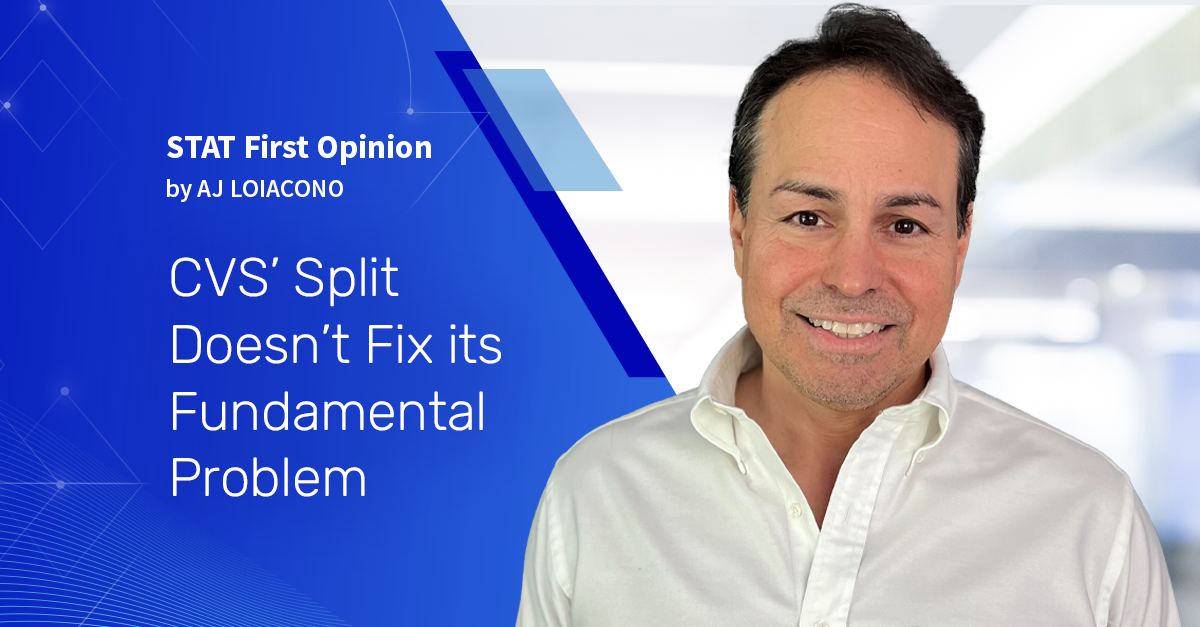


This article was originally published by STAT First Opinion (subscription required) on Nov. 9, 2026.
CVS Health is one of the largest companies in the U.S. It serves the health care needs of hundreds of millions of Americans annually, has a hand in nearly every part of the drug supply chain, and has more than $400 billion in annual revenue.
So when it announced last Wednesday that it will split into two entities, the news made waves.
Here’s the thing: Much of the media coverage frames this move as CVS unwinding its vertical integration in response to ongoing regulatory pressure. That is not what is happening here.
Look at what CVS is signaling to do. One company, CVS Pharmacy, will take the roughly 9,000 retail stores, the mail-order pharmacy, and the MinuteClinics.
The other, potentially keeping the CVS Health name, will hold Aetna; Caremark, the pharmaceutical benefits manager (PBM); CVS Specialty, which is their dispensing pharmacy for medications that treat complex, rare, or chronic health conditions; and Cordavis, the company’s biosimilar manufacturing subsidiary.
And that is what we should be paying attention to. When specialty drug spend represents roughly half or more of pharmacy spend for the average employer, and biosimilar share continues to grow, having the production of medication and access controlled by one entity is problematic for reasons I’ll explain.
Related Content: STAT+ Business - CVS Health to split, reversing years of deal-making to combine pharmacies and insurance
Said differently, keeping the PBM and specialty pharmacy together, along with a manufacturing subsidiary, does not unwind the issues with vertical integration that matter most, it preserves them.
In recent months, we have seen tectonic shifts in federal regulatory action that will impact the future of health care and health benefits:
- The Transparency in Coverage rule aims to bring health care prices into the open through machine- and human-readable formats, helping employers and consumers better understand their care costs.
- The Department of Labor’s final Improving Transparency into Pharmacy Benefit Manager Fee Disclosure rule requires PBMs and other vendors to a plan to clearly report their direct and indirect compensation, including any rebates and other fees associated with dispensing prescription drugs and providing care to plan members.
- The requirements in the Consolidated Appropriations Act of 2026 also align or overlap with the new DOL rule.
Taken together, this regulatory push promotes the sharing of price and plan data in ways that tip the balance of power to buyers — patients and America’s employers who provide health benefits to most of the insured population. The goal is for patients and plan fiduciaries to make more informed health care-related purchasing decisions, which is a very reasonable and sensible effort.
The CVS business split follows recent transparency shifts announced by Cigna and UnitedHealth Group. Together, CVS, Cigna, and UnitedHealth Group own the PBMs known as “the big three.” While these developments represent marked improvements in some areas, they all fall short for one simple reason: They do not separate drug fulfillment, particularly specialty pharmacy, from PBM administration.
If a patient still gets their specialty medication from a pharmacy owned by the PBM, or the PBM’s parent company, then a fundamental conflict still exists. Survey data show that drugs for cancer, multiple sclerosis, and other complex conditions, which are among the most frequently filled drugs by specialty pharmacies, account for the majority of the cost inflation plan sponsors see in their pharmacy spend.
As the CEO of a PBM that does not own a pharmacy or otherwise profit from a plan sponsor’s drug spend, I can assure you that it is not necessary for a PBM — or its parent company — to own a specialty pharmacy.
Cigna sent a similar signal to the market when it discussed leaning into the specialty pharmacy business during its most recent investor day presentation, and Optum Rx’s recent promise to pass through 100% of rebates and be more transparent reflects the same hand wave. Importantly, the big three are trying to address the pressure from the government, but at the end of the day, they are keeping together the businesses that create an inherent conflict of interest — the insurers, the PBMs, and the specialty pharmacies.
Related Content: STAT+ Business - New federal rule will require prescription drug middlemen to share secret payments data
PBMs were created to administer pharmacy benefit programs, not monetize every decision inside them. Since the early 2000s, their role has evolved from orchestrating all the behind the scenes complexity that supports plan members’ access to drugs to profiting from clinical and other decisions, including which drugs are preferred on the formulary, which pharmacies are in or out of the network, and where high-cost specialty drugs are filled.
Transparency should not have to be forced by government action. It should not be a marketing pivot or a convenient sound bite. PBMs should operate in a way that allows plan sponsors to fulfill their fiduciary obligations, with complete transparency into how their benefit dollars are spent. They should make money managing the pharmacy benefit, not monetizing the drugs flowing through it.
There is no ambiguity when it comes to the conflict of interest of owning dispensing assets — it is a conflict of interest if a PBM, the plan sponsor’s delegated administrator, makes more money on a clinical decision, fulfillment steerage, drug classification, or a prescription override.
If the big three are serious about eliminating conflicts of interest and aligning with plan fiduciaries, the path is straightforward: Separate the PBM from the dispensing assets. If they never do so, every plan sponsor who utilizes a PBM with a conflict of interest should understand the impact to their members and the unnecessary exposure to fiduciary liability.
A.J. Loiacono is CEO of Judi Health.
Letter to the editor
Have an opinion on this essay? Submit a letter to the editor.