Judi Health Partner Summit 2026 Highlights: Progress is Impossible to Ignore


.webp)


“Everyone has been making too much money. Nobody stopped to think about the impact on [patient] care. Once you see everything in real time, you’re not going back to the past.” - AJ Loiacono, Co-Founder & CEO, Judi Health
When the 2026 Partner Summit in Fort Lauderdale was opened with those words, the room understood exactly what kind of conversations were about to happen. The health benefits industry has entered an “era of acceptance,” where employer plan sponsors will no longer work with vendors whose systems are decades old, structurally resistant to collaboration, and built around everything except delivering exceptional member service and positive health outcomes. Here are the highlights from this year’s discussions, covering topics ranging from drug pricing and procurement to client stories and the future of enterprise health technology, starting with the question every employer in the room was already asking.
Who's Paying for Drug Price Hikes?
So, what was the primary takeaway from this lively discussion between AJ Loiacono, Mark Cuban of Mark Cuban Cost Plus Drugs, and Antonio Ciaccia? The future “is dependent on the decisions made by employers – the people paying the bills,” said Antonio.
“What you’ll see are more last gasps for air where arbitrage opportunities live under bloated prices.” - Antonio Ciaccia, President, 3 Axis Advisors/46brooklyn Research
The panel didn’t mince words about why the system stays broken. AJ pointed out that traditional pricing models, particularly the industry standard, Average Wholesale Price (AWP), tell plan sponsors “absolutely nothing” about what a drug costs. The entire supply chain, from, wholesalers to PBMs to insurers, thrives on contracts predicated on bloated, inflated prices, and nobody has the structural incentive to lower them. When the pie is bigger, everybody gets a bigger slice.
And Mark Cuban offered insightful commentary around negotiating and making drug prices publicly available, the rise of unbundling and direct contracting as a remedies for market dysfunction, and empowering employers to take back control of their health plans. When plan sponsors leverage transparent pricing and make their own formulary decisions, every penny saved goes directly to their bottom line.
That said, if we look at where the leverage points remain – deductibles, plan design and coinsurance, formulary, etc. – and continue to allow the Big 3 to define those and “set the rules,” Mark thinks we’re in trouble.
The PBM Reform Road Trip
“The states and feds are behind us, we’re very supportive of it. Because we believe if you’re transparent, you know where the money is, and you know where you want to invest.” - Lloyd Fiorini, General Counsel & Chief Compliance Officer, Judi Health
Lloyd Fiorini and SVP of Strategy, Josh Golden, took the audience on a road trip, traveling through states that are rapidly shifting PBM reform legislation, including the CAA 2026, DOL's proposed PBM rules, and more.
At the federal level, the passing of the Consolidated Appropriations Act of 2026 and the recent rule announcement from the Department of Labor signal that momentum is building. The fireside chat also covered the Federal Trade Commission’s settlement with ESI, the concept of delinking PBM profit from drug price and volume, and how fiduciary breach plays out in the real world.
From Florida to Arkansas to California, state legislatures are attacking spread pricing, vertical integration, and traditional PBM opacity at a pace the industry hasn’t seen before. Lloyd’s take on the resulting patchwork of rules was characteristically direct, describing it as a headache for multi-state clients, but for an organization that’s already been operating transparently, none of it required specific change. The direction is consistent, and employers should finally be able to see how their plan dollars are being spent.
What Transparent PBM Partnership Looks Like
Nick Van Hook, Judi Health’s SVP of National Business Development, moderated a client panel featuring Dr. Debra Bell (WellSpan Health), Héctor W. Ramirez (Memorial Hermann Health Plan/Apex Health Solutions), Ben Knuckles (Baptist Health), and Veronica Villaseñor (Rice University), who shared what moving to a transparent PBM looks like for the organizations living it.
Rather than waiting weeks for a nameless representative to return an email, panelists described how modern technology and attentive account managers allow them to track outliers, review data, understand their options, and implement changes in real time. Veronica noted that her organization was projected to save $6.8M over three years, and net savings are on track. Rice saw 5% savings in the first year including coverage of GLP-1s. “The ability to give faculty and staff time to focus on what they are there for is priceless,” she added.
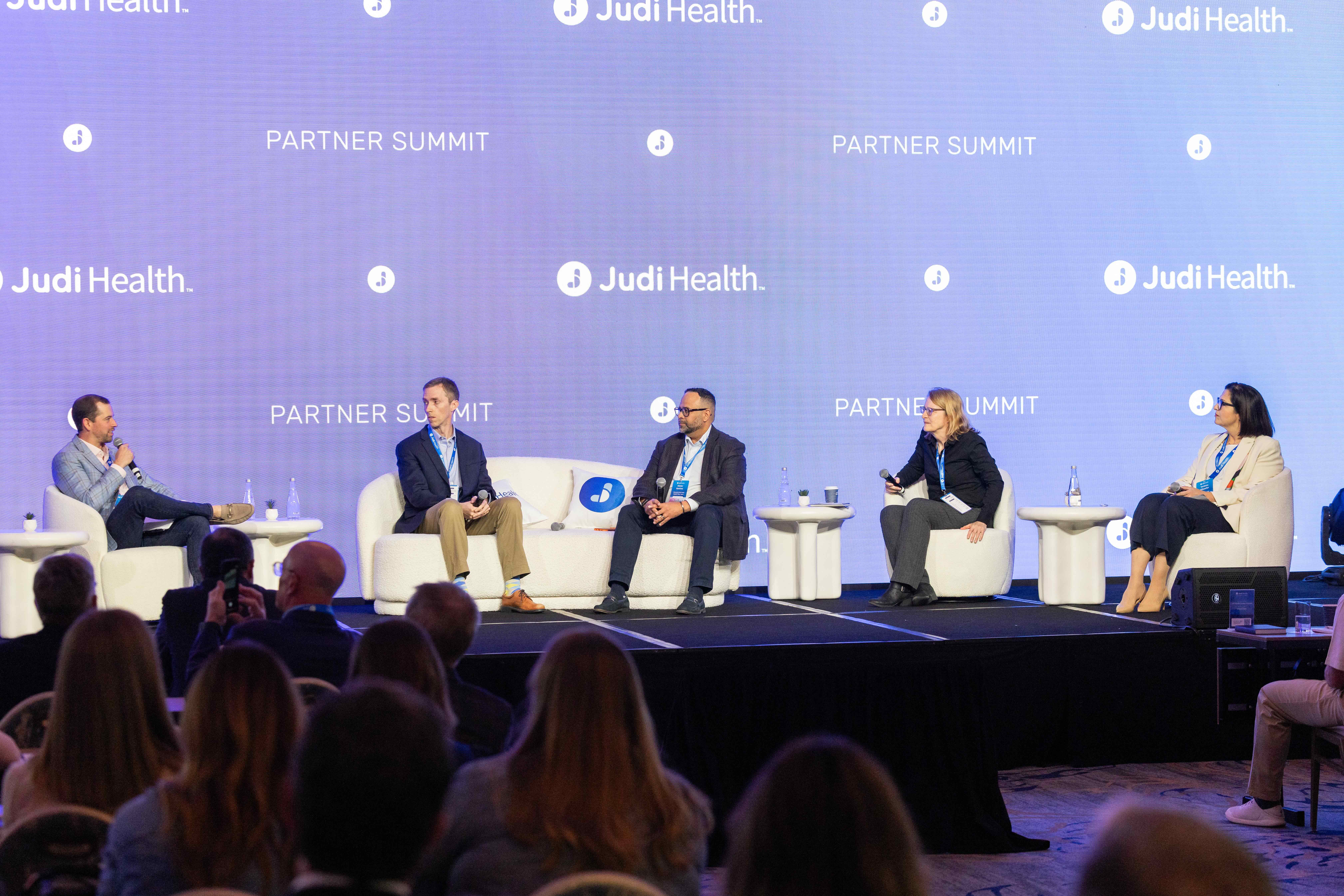
Ben Knuckles, with Baptist Health, shared the unique perspective of a client who left Judi Rx for a different PBM, only to return a year later in 2026. He was direct about what makes difference for him: a partner that gives you faces, names, data, and answers instead of a support email that takes a week to respond.
Dr. Bell described how clear visibility and a wraparound approach allowed her team at WellSpan Health to proactively adopt biosimilars, achieving 100% adoption through collaboration with providers and significantly improving the plan experience while saving money in 2025.
“We worked together to develop a gold-carding process with certain groups of oncology providers—that shortened timelines, and I get to be a hero, which isn’t always the case.” - Dr. Debra Bell, Medical Director for Accountable Care, WellSpan Health
Hector had a unique perspective, being from Texas where requirements for health plans are not “one size fits all.”
“We can’t steer and need to open everything to members and providers. So, on the commercial side, we work closely with the clinical team to implement better rules,” he said.
Is PMPM Innovation or Just Insurance with a New Name?
Judi Health’s Kristin Begley, PharmD (Chief Commercial Officer), Sara Izadi, PharmD (Chief Clinical Officer), Maria Espinosa (SVP, RFP Underwriting), and Mike Miele, FSA, MAAA (SVP, Insured Services), tackled one of the thorniest questions in healthcare financing: when does innovation just become another form of insurance?

The panel explained that unit cost only assesses about 30% of future costs, with the rest driven by drug mix and utilization strategies, and common PBM tactics are making the gap wider for employers who aren’t looking closely enough at their contracts. Kristin and Maria walked through the fact that the industry is plagued with whack-a-mole on optics, but gaps are widening more with high-WAC vs. low-WAC biosimilars, for example. Maneuvers like re-bucketing (where a drug gets quietly moved to a different pricing tier to make rebates look better on paper) and over-supplying through early refills can contribute to plan costs in ways that are difficult to spot without the right data and a partner willing to flag them.
“The person who picks the highest, most expensive drug gets the best rebates and is guaranteed to win...on a spreadsheet.” - Kristin Begley, PharmD, Chief Commercial Officer, Judi Health
On the clinical side, utilization management backed by high-touch member care is one of the most effective tools employers have to build more predictable pharmacy spend, something Sara and her team see play out across their book of business.
Where Mike drew the sharpest line was on guarantees, emphasizing that there’s a meaningful difference between a utilization guarantee, where a PBM commits to specific measurable improvements, and a PMPM or trend guarantee, where a budget gets set at the PBM absorbs the overage. The panel stressed that many employers don’t fully appreciate how important it is to understand both the model they’re choosing and the accountability tied to it before going into a contract.
The Fiduciary Risk Employers Can’t Ignore
Jeff Hogan, Managing Director and Co-Founder (Judi Group), moderated a conversation with fellow Judi Group team members, Julie Selesnick, Executive Director of Legal and Compliance, and Jason Aulakh, Executive Director of Product and Innovation, on what employers are on the hook for in today’s regulatory environment.
With family coverage rates hitting $70,000 for jumbo employers, plan sponsors can no longer afford to treat contract review as an afterthought. Julie walked through why most employers don’t have access to their own contracts, haven’t examined required compensation disclosures, and have little insight into whether their plan is spending reasonably on behalf of members, adding that under the Consolidated Appropriations Act of 2021 and 2026, and the new Department of Labor rules, that’s no longer a defensible position.
“To be a good fiduciary you make prudent decisions, you’re loyal, and you make decisions – including selecting service providers – that are solely in the best interests of the plan and the plan’s members.” - Julie Selesnick, Executive Director of Legal and Compliance, Judi Group
The panel offered a clear action plan for employers:
- Demand complete compensation disclosures before signing any contract
- Conduct forensic reviews of plan documents to close compliance gaps
- Remove gag clauses and anti-competitive provisions that block access to your own claims data
- Ensure you have a clear process to evaluate your plan’s needs and spending
Jason made the case that the tools to fix it already exist in forensic data analysis, better contract review processes, and technology that gives employers visibility into their own claims data. The wave is cresting, and employers who haven't examined their plans are about to feel it.
The Role of Care Navigation: When Pharmacy and Medical Work Together

“When you’re making such a large change, and you’re so used to doing things a certain way, to have a team that listens and a collaborative effort, that’s what makes it successful.” - Maria Scheeler, Executive Director / Administrator, Teamsters Health & Welfare and Pension Funds of Philadelphia and Vicinity
AJ Loiacono moderated the 2026 Summit’s closing session alongside Sunil Budhrani, MD, MPH, MBA (Chief Innovation & Medical Officer, Judi Health), Andy Kageleiry (SVP, Enterprise, Judi Health), and Maria Scheeler, whose fund was among the first to run unified pharmacy and medical claims on the Judi Platform.
Maria shared her experience moving off a 20-year-old legacy system, describing how the transition unified her team’s claim processing across six different plans and has the potential to cut out-of-network claims in half. Automated capabilities handled complex carve-outs and eligibility files that had previously required manual workaround for decades, and her team's reaction captured it simply: Judi does everything.
Dr. Budhrani reflected that as a physician, the same opacity that frustrated him at the bedside is exactly what the platform is built to eliminate. By running medical, pharmacy, dental, and vision on the same unified code base, employers can finally act like true payers with full visibility into the care their members are receiving. Andy brought that to life on the navigation side, describing how Judi Care connects back-end claims infrastructure to a front-end member experience that guides people to high-quality, cost-effective care through personalized navigation.
Whether a plan sponsor wants to implement dynamic copay plans, a trend Andy described, help members access direct primary care, or build a custom network, the technology finally exists to make those brilliant healthcare ideas a reality.
Progress Is No Longer Optional
The 2026 Partner Summit made one thing clear, the era of accepting opaque contracts, misaligned incentives, and outdated technology is over. Employer plan sponsors have more leverage than they’ve ever had, and the tools to use them are in reach.
Will we see you next year? Get in touch with our team to learn more.





.webp)